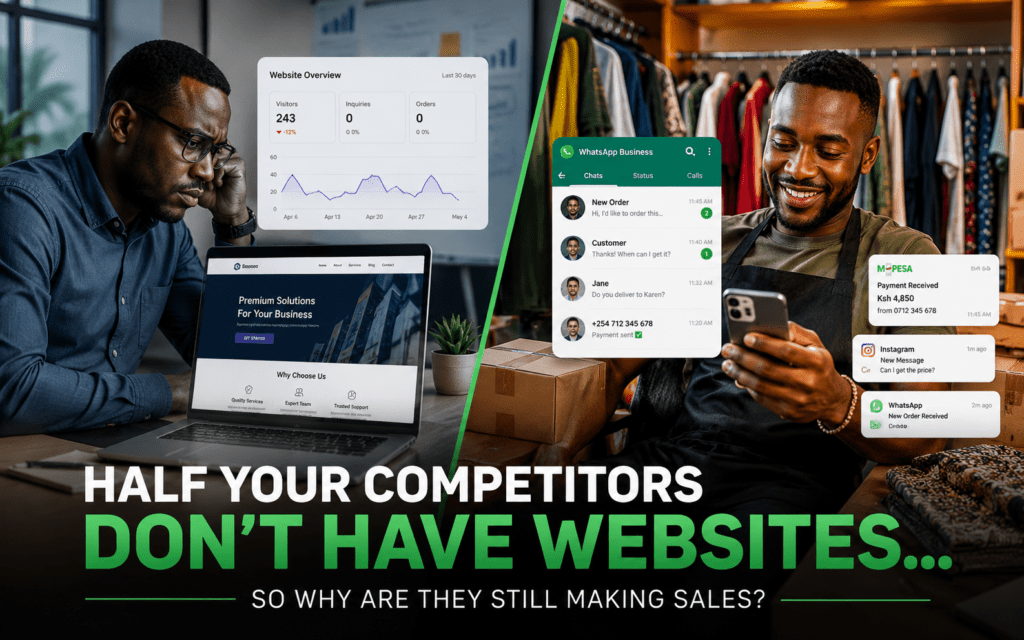
Half your competitors have no website and they are still making sales. So why does every marketing agency keep telling you that you need one?
Here is my honest take. Not the agency pitch. Not the version designed to get you to sign a contract. The version I would tell a friend over lunch at Kwetu in Kilimani. Have you been there? The fish is something else. Anyway.
You Can Run a Real Business Without a Website in Kenya
Let me start by saying something most web designers will never say. You do not always need a website.
Nearly half of Kenyans have already bought something through social media, according to a 2024 study by The Standard. WhatsApp catalogs, Instagram DMs, Facebook Marketplace. Whole businesses are running on these platforms and turning real profit. The mama who sells chapati supplies in Eastleigh, the baker in South B who posts reels of her cakes every morning, the second-hand clothes dealer in Gikomba who runs their entire operation through WhatsApp broadcasts. These people are making money without a single line of code or a hosting plan.
So if someone tells you that you absolutely need a website to do business in Kenya, they are either selling you something or they have not spent much time watching how commerce actually works here.
That said, let us talk about what a WhatsApp-only or Instagram-only setup cannot do. Because that is where the real conversation starts.
You Are Only Reaching People Who Already Know You Exist
This is the thing that nobody says clearly enough.
WhatsApp reaches your contacts. Instagram reaches your followers. Both platforms, as powerful as they are, operate as closed loops. The people inside them already know you, or they followed you because someone they already knew shared your content.
A website does something completely different. It reaches strangers.
Right now, someone in Nairobi is typing “interior designer Kilimani” into Google. They have never heard of you. They have never seen your Instagram. They are not in your WhatsApp contact list. But if your website is properly set up, your name appears in front of them at the exact moment they are looking for what you offer.
That is a type of discovery that WhatsApp and Instagram simply cannot give you. Not because they are bad platforms. But because they were not designed for it.
The Rented Land Problem
In November 2024, WhatsApp Web went down. Not for five minutes. For days. From Monday November 25 to Wednesday November 27, businesses across Kenya running their customer communication through the browser version of WhatsApp lost their channel entirely. Mobile app users fared slightly better but the disruption was widespread and lasted the better part of a week. Orders were missed. Customers could not get through. Revenue stopped.
This is the rented land problem. You do not own your Instagram following. You do not own your WhatsApp contacts in any meaningful digital sense. Meta can change the algorithm, restrict your account, or simply go offline. And there is nothing you can do about it.
Your website is the only piece of digital real estate that actually belongs to you. The domain is yours. The content is yours. The traffic is yours. Nobody can take it away because a server in California had a bad day.
I have audited hundreds of websites across Kenya and East Africa. One of the first things I look at is how dependent a business is on platforms they do not control. The ones that are entirely dependent on social media are one algorithm change away from starting over.
What About Google Business Profile?
This comes up a lot. If you have a fully optimised Google Business Profile, you appear on Google Maps, you show up in local search results, and customers can call you, get directions, and read your reviews without ever visiting a website. So does that count?
Partly. And here is something most people do not realise. A Google Business Profile ranks faster than a website. Significantly faster. A new website can take three to six months before it starts appearing meaningfully in Google search results. A well-optimised Google Business Profile can show up in the Local Pack within weeks of being set up and verified. For a new business that needs visibility quickly, this is one of the most underused advantages available in Kenya right now.
For a local business serving a specific area, a complete Google Business Profile is one of the highest-return things you can do and it is completely free. A salon in Westlands, a hardware shop in Mombasa, a dental clinic in Kilimani. For these businesses, showing up in the Local Pack on Google Maps can drive more walk-in traffic than a website ever would on its own.
Bing Places works the same way on Microsoft’s search engine, which still matters for business travellers and corporate clients accessing the internet through work devices and Microsoft browsers. It takes twenty minutes to set up and most Kenyan businesses have never touched it. That is a free visibility gap most of your competitors have not thought about.
But here is the limitation of the GBP alone. It tells people you exist. It does not tell them much about what you do, who you have worked with, why you are credible, or how to make a decision to hire you over a competitor. You get a description, some photos, your services list, and your reviews. That is the ceiling.
There is also a vulnerability with Google Business Profile that nobody talks about until it happens to them. Fake negative reviews. A competitor with a small budget and zero ethics can commission a batch of one-star reviews overnight. A disgruntled ex-employee. A client dispute that goes sideways. Someone who simply does not like you. Your rating goes from 4.8 to 3.1 in a weekend and your phone stops ringing on Monday. Businesses that took years to build have collapsed faster than the Titanic because their entire customer acquisition depended on a GBP rating they had no real control over. Google’s review removal process is slow, bureaucratic, and not guaranteed to work in your favour even when the reviews are obviously fake. If your GBP is your only digital home, that is your entire business sitting on someone else’s land with no fence around it.
A law firm cannot explain its expertise in a GBP description. A safari company cannot show its itineraries and client testimonials. A hotel cannot convey the experience of staying there. For anything beyond basic discovery and contact, you need the website behind the profile.
The Google Business Profile is the signpost. The website is the destination. Social media is the word of mouth. WhatsApp is the handshake. All four working together is what a complete digital presence looks like for a Kenyan business in 2026.
27.4 Million Kenyans Are Searching. Are They Finding You?
Kenya has 27.4 million internet users. Not all of them are following you on Instagram. Most of them will find out about you, if they ever do, through a Google search.
A business with no website cannot rank on Google. It cannot appear properly in Google Maps. It cannot be mentioned by ChatGPT or Gemini when someone asks for a recommendation in your category. All of those discovery channels require a website as the foundation.
Think about it from the other side. A travel agent in Dubai is looking for a reliable safari operator in the Masai Mara for a high-end client. They open Google and search. They are not scrolling through Instagram to find you. They are not in your WhatsApp broadcast list. If your business does not appear in those results with a credible, informative website behind it, you do not exist to that person.
The Trust Gap That Social Media Cannot Close
Here is something I have learned from working with hotels, law firms, safari companies, and real estate developers across Kenya and East Africa. There is a ceiling on what Instagram can do for credibility.
When the procurement manager of a Nairobi corporate is looking for a law firm to handle a transaction, they do not DM anyone on Instagram. They search for the firm, find the website, read the practice area pages, check the team credentials, look for case studies. If there is no website, or if the website looks like it was built in 2014 and last updated when Uhuru was still president, the conversation is over before it starts.
Same for a family in London planning a safari. Same for a Singapore investor looking at Kenyan real estate. Same for the HR director shortlisting executive coaching firms. High-value decisions require a level of credibility that a social media page cannot provide on its own.
This is not about aesthetics. It is about the signal a website sends. It says we are serious enough about this business to build a proper home for it online.
When You Genuinely Do Not Need a Website Yet
I said I would be honest and I meant it.
If you are testing a product idea, a website is premature. Use Instagram Shops or a WhatsApp catalog to validate demand first. If you are a purely local service business serving the same neighbourhood, a fully optimised Google Business Profile combined with a strong WhatsApp presence may be all you need for now. If you are bootstrapping and every shilling matters, invest in what generates revenue first. A website built before you have any customers is a distraction, not an asset.
The key word there is yet. The businesses that avoid websites forever are the ones that stay small. The ones that build them at the right time are the ones that scale.
The Businesses That Cannot Afford to Not Have One
If you are in any of the following situations, a website is not optional.
You are targeting people who do not already know you exist. You need to rank on Google for any keyword related to your business. You are in a high-value service category where clients need to vet you before making a decision. You want to compete for international customers. You run a hotel, lodge, safari company, law firm, clinic, real estate agency, or any professional services business. You want to appear in AI search results when someone asks ChatGPT or Gemini for a recommendation in your category.
Every single one of these scenarios requires a website as the foundation. Without it, you are asking customers to trust you with significant money based on a 150-character Instagram bio and a few posts they may never even see.
Most Kenyan Business Websites Are Not Doing the Job
This is the part nobody wants to say out loud. Having a website and having a website that works are two very different things.
I have done hundreds of audits across Kenya, Tanzania, and Uganda. The majority of business websites I open load slowly on mobile. Half of them have no clear call to action. A significant number have no M-Pesa integration despite their customers expecting to pay via M-Pesa. Some are completely unreachable from international IP addresses because of a security plugin that was never configured properly, which means Google’s crawlers cannot read them either. The business owner has no idea. They think they have a website. What they actually have is a slow, broken page that is costing them customers every single day.
A bad website is almost worse than no website. It creates a first impression that tells a potential customer you are either not serious or not paying attention. On mobile, where over 70% of Kenyan internet traffic comes from, a slow or broken website is a direct conversion killer.
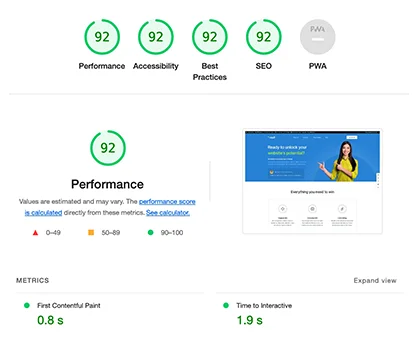
What a website should actually do is not complicated. Load in under three seconds on a 4G connection. Have one clear action for the visitor to take. Work properly on a Tecno or Samsung phone. Make it easy to contact you on WhatsApp or by phone. And if you sell anything, accept M-Pesa without the customer having to go through four steps to get there.
The Combination That Actually Works
The businesses growing fastest in Kenya right now are not choosing between WhatsApp and a website. They are using all four layers deliberately.
The website is the foundation. It captures the stranger who finds you through Google at 11pm when your WhatsApp is off. It ranks for keywords. It gives AI assistants something credible to cite when recommending businesses in your category. It works while you sleep.
The Google Business Profile is the street presence. It puts you on the map, literally. When someone searches “private clinic Kilimani” or “lawyer near me” on Google, the Local Pack of three businesses that appears at the top of the results is powered by Google Business Profiles. A complete, well-optimised profile with photos, services, regular posts, and genuine reviews is what gets you into that pack. Bing Places does the same job for Microsoft’s search ecosystem, reaching corporate clients and business travellers searching from work devices. Both are free. Both take an afternoon to set up properly. Neither should be ignored.
Social media is the awareness layer. Instagram, TikTok, Facebook, LinkedIn depending on your audience. This is where people discover you through content, through referrals from people they follow, and through paid promotion. Social media builds familiarity. It is the reason someone already recognises your name when they eventually search for you on Google.
WhatsApp converts the lead. Once someone has found you through any of the above, the fastest way to close them in Kenya is a direct conversation. A WhatsApp link on your website, a clear click-to-chat button, a phone number that goes straight through to a real person. That is where trust closes into a transaction.
Think about a clinic in Kilimani running all four layers properly. The website ranks for “private clinic Kilimani” on Google. The Google Business Profile appears in the Local Pack when someone nearby searches on their phone. The Instagram page builds familiarity through health tips and team content so the name feels known before the first visit. And the WhatsApp link on the website converts a first-time visitor into a booked appointment in under three minutes.
The website did the discovery. The GBP did the local visibility. Social media built the trust over time. WhatsApp closed the deal. Take any one of those four out and the chain has a gap in it.
That is the complete digital setup for a serious Kenyan business in 2026. Not the most expensive. Not the most complex. Just the most logical given how Kenyans actually research, compare, and buy.
The question is not whether you need a website. The question is whether the one you have is actually doing anything useful. And for most Kenyan businesses, the honest answer to that second question is no.