Roy Safaris had a Tanzania safari product that could compete with anyone. The website told a different story. When Nairobi Marketing, a Nairobi-based digital marketing agency specialising in SEO for East African hospitality and tourism businesses – pulled the initial audit in late 2025, the site was set to no-index, a single directive that was telling Google, quietly and completely, to ignore everything on it.
The result was predictable. Thirty-two organic clicks in a full month. Three ranking queries. Two pages getting any traffic at all. A business operating in one of the most searched travel categories on the planet, effectively invisible.
This is what happened next.
The Diagnosis: One Setting, Total Suppression for months!!
No-index sounds like a minor technical issue. It isn’t. When a site carries that directive, search engines don’t just rank it poorly – they remove it from consideration entirely. No impressions for non-branded queries. No organic footprint. Nothing to build on.
Before any content or keyword work made sense, the technical foundation had to be rebuilt from scratch.
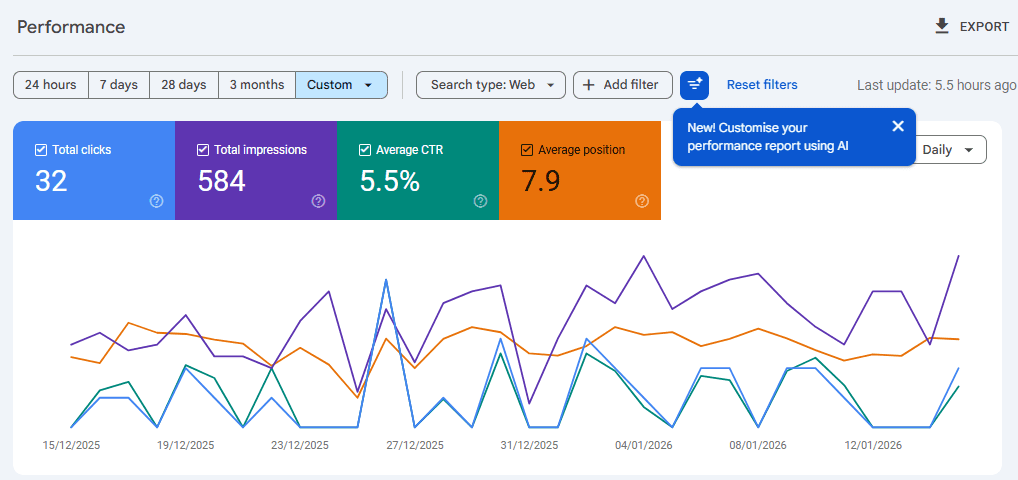
What the Google Search Console data showed at the start:
| Metric | Before (Dec 15 – Jan 15) |
|---|---|
| Total Organic Clicks | 32 |
| Total Impressions | 584 |
| Ranking Queries | 3 |
| Pages Getting Traffic | 2 |
| “roy safaris” Average Position | 8.53 |
| “roy safaris” CTR | 4.29% |
Three queries. Both of them branded. The site existed on Google only because people already knew the name and searched for it directly. For anyone who didn’t already know Roy Safaris, the website simply did not exist.
Phase 1: Getting Google Back In
The recovery started with the no-index removal, but that’s not as simple as flipping a switch. Done wrong, a sudden re-entry into Google’s index after suppression can trigger crawl anomalies, duplicate content flags, and indexation chaos.
Nairobi Marketing audited robots.txt line by line, confirmed crawl permissions across all key directories, submitted a clean XML sitemap, and manually triggered indexing for priority pages through Search Console. Canonical inconsistencies got fixed at the same time – duplicate URL variations that would have confused Google’s understanding of which pages to surface.
Internal linking architecture was strengthened so that when Googlebot did start crawling, it could move through the site efficiently and understand the relationship between pages.
Within days, Google was crawling properly. Within the first two weeks, the impression curve started moving.
Phase 2: Schema and Structured Data
Crawling and indexing gets you back in the room. Schema is what tells Google what the site is actually about.
We implemented structured data across the site targeting the specific entity types relevant to a Tanzania safari operator: Organization schema anchoring the brand identity, Tour and travel-related schema for itinerary pages, FAQ schema on safari information pages, and Article schema for editorial content. This is part of Nairobi Marketing’s standard technical SEO framework for hospitality clients across Kenya and East Africa.
This matters more than most site owners realize. Search engines don’t just read text — they build entity graphs. Schema accelerates that process, making it explicit rather than inferred. For a site recovering from suppression, it compressed weeks of organic understanding into days.
Phase 3: Meta Titles and CTR Engineering
Visibility without clicks is impressions. Impressions without a revenue connection are vanity.
The existing meta titles on Roy Safaris were generic. They didn’t signal intent. They didn’t include the geographic modifiers – Tanzania, Serengeti, Ngorongoro, Arusha – that high-intent safari searchers actually use. They didn’t differentiate in a SERP full of OTA listings and aggregator pages.
We rewrote them. Every priority page got a title built around the specific query it was meant to capture, with geographic specificity and enough differentiation to stand out against the OTA-heavy competition.
The CTR data is the cleanest proof of what this achieved.
“Roy safaris” – the core branded query – went from a 4.29% click-through rate to 22.84% in the same 30-day comparison window. Same query. The site just became dramatically more compelling to click.
Phase 4: AI Search Optimization
Modern search recovery doesn’t end with Google’s blue links.
Parallel to the technical and on-page work, we ran entity reinforcement across the site – strengthening the semantic connections between Roy Safaris and the specific locations, experiences, and travel categories they operate in. This isn’t keyword stuffing. It’s building the entity relationships that allow AI systems to confidently associate the brand with the queries being asked.
Query fan-out coverage was a specific focus. When someone asks an AI model about Tanzania safari companies, or 5-day Serengeti itineraries, or family-friendly safari operators in northern Tanzania, the model runs multiple sub-searches before writing a response. Pages need to exist that answer those sub-searches specifically – not just the top-level query.
Within the recovery window, Roy Safaris began appearing in Google AI Overviews for safari-related queries and recommended as a brand for tours and safari. That’s a signal that the entity work is landing.
The Results: 30 Days of Recovery
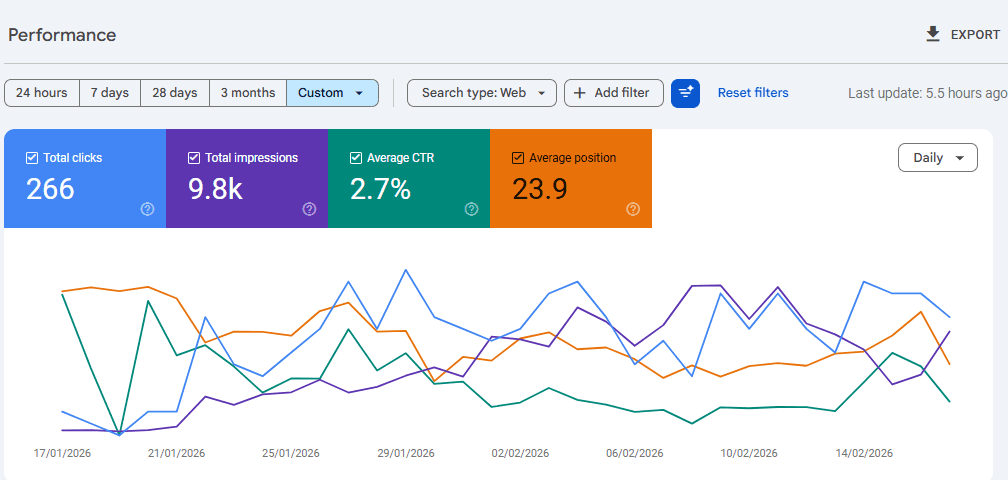
Google Search Console data comparison — same period length, consecutive months:
| Metric | Before | After | Change |
|---|---|---|---|
| Total Organic Clicks | 32 | 266 | +731% |
| Total Impressions | 584 | 9,799 | +1,578% |
| Ranking Queries | 3 | 442 | +14,633% |
| Pages Getting Traffic | 2 | 93 | +4,550% |
| Countries with Impressions | 5 | 213 | +165% |
| “roy safaris” Average Position | 8.53 | 3.27 | Improved |
| “roy safaris” CTR | 4.29% | 22.84% | +432% |
The impression growth tells the indexation story. The query expansion from 3 to 442 tells the topical authority story. The CTR improvement on branded queries tells the meta optimization story. Together they show a site moving from technical suppression to genuine search presence across all the layers that matter – traditional rankings, structured data eligibility, and AI retrieval.
Ninety-three pages getting traffic where two were getting traffic before. That’s not the same site performing better. That’s a fundamentally different digital asset.
What This Means for Safari Operators
Roy Safaris isn’t an outlier case. Across Kenya, Tanzania, and East Africa’s broader hospitality and tourism sector, technically suppressed websites are more common than most operators realize. No-index directives left over from development builds. Robots.txt files that were never cleaned up after site migrations. Schema that was never implemented. Meta titles written for designers, not search engines.
The organic search opportunity in Tanzania safari queries is significant and most of it remains uncaptured by the operators who actually offer the product. The OTAs and aggregators dominate because they execute technical SEO correctly, not because they have a better product.
The gap is closeable. Roy Safaris’ 30-day recovery is one example of what structured technical execution looks like when applied to a site that was suppressed rather than genuinely weak.
If your lodge, camp, or safari operation has organic traffic that looks like the “before” numbers above, the problem is almost certainly technical before it’s anything else. Nairobi Marketing is a Kenya-based digital marketing agency specialising in technical SEO recovery, AI search optimisation, and content strategy for hospitality and tourism operators across East Africa. View our digital marketing services in nairobi..