You have probably clicked a Google Ad without knowing it. Most people have. The blue link looked relevant, you clicked, and somewhere a business paid between Ksh 30 and Ksh 600 for that single moment of your attention.
That transaction happens billions of times a day globally. In Kenya alone, over 9,900 people search for information about Google Ads every month, most of them business owners trying to figure out whether it is worth it for them. This guide answers that question directly, with real costs in Kenyan shillings, a clear explanation of how the auction works, and an honest assessment of when Google Ads makes sense and when it does not.
What Are Google Ads?
Google Ads is a paid advertising platform that allows businesses to show their ads on Google Search results, YouTube, Gmail, and millions of websites across the internet. You set a budget, choose the keywords you want to appear for, write your ad, and pay each time someone clicks.
The model is called pay-per-click, or PPC. You are not paying for people to see your ad. You are paying only when someone clicks it and arrives at your website or landing page. If nobody clicks, you pay nothing.
When you search for something on Google and see results labelled Sponsored at the top of the page, those are Google Ads. The businesses behind them did not earn those positions through SEO. They bought them. And they keep them only as long as they keep paying.
How Google Ads Work: The Auction System
Every time someone in Kenya types a query into Google, an auction runs in a fraction of a second. Hundreds of advertisers may be competing for that moment of attention. Google decides who appears and in what position using two main factors: how much you are willing to pay per click, and how relevant and high-quality your ad is.
The Bid
When you set up a Google Ads campaign, you tell Google the maximum amount you are willing to pay each time someone clicks your ad. This is your bid. A law firm in Westlands might bid Ksh 400 per click for the keyword “advocate Nairobi.” A restaurant in Kilimani might bid Ksh 50 per click for “lunch Kilimani.”
Higher bids generally lead to higher placement. But bid alone does not determine who wins.
The Quality Score
Google assigns every ad a Quality Score, rated from 1 to 10. It is based on three things: how relevant your ad is to the keyword someone searched, the expected click-through rate of your ad, and the quality of the landing page your ad points to.
A business with a Quality Score of 8 and a bid of Ksh 200 can outrank a competitor with a Quality Score of 4 and a bid of Ksh 400. This means that better ads cost less and rank higher. Google rewards relevance because its business depends on showing users ads they actually find useful.
Ad Rank
Google multiplies your bid by your Quality Score to produce your Ad Rank. The advertiser with the highest Ad Rank gets the top position. This system means that a well-structured, relevant campaign from a Nairobi SME can compete with and beat a large corporation spending far more, simply by being more relevant to what the searcher actually wants.
The Types of Google Ads Available in Kenya
Google Ads is not just one thing. It is a platform with several different ad formats, each serving a different purpose.
Google Search Ads
Search ads are the text results marked Sponsored that appear at the top and bottom of Google search results pages. They are triggered when someone types a keyword you are targeting. They are the most commonly used format for Kenyan businesses because they capture people who are actively searching for exactly what you offer.
A plumber in Nairobi running Search Ads for “plumber Westlands” reaches only people searching for a plumber in Westlands right now. The intent could not be higher.
Google Display Ads
Display ads are visual banner ads that appear on websites, apps, and YouTube across Google’s Display Network. Unlike Search ads, they reach people who are not actively searching for you at that moment. They are used for brand awareness, reaching new audiences, and remarketing to people who have already visited your website.
A hotel in Nakuru can run Display Ads that follow recent visitors to their website across the internet, reminding them of the hotel they almost booked.
Google Shopping Ads
Shopping ads show product images, prices, and store names directly in Google search results. They are specifically for ecommerce businesses selling physical products. A clothing store on Ngong Road can show their products with photos and prices to anyone in Kenya searching “women’s dresses Nairobi” without them needing to visit the website first.
YouTube Ads
YouTube ads appear before and during YouTube videos. Kenya has 11 million YouTube users according to DataReportal’s Digital 2025 Kenya report. YouTube ads work best for brand awareness, product demonstrations, and reaching audiences who respond to video content. A real estate developer in Karen can show a video walkthrough of a new development to Kenyans watching property-related content on YouTube.
Performance Max Campaigns
Performance Max is Google’s most automated campaign type. You provide creative assets including headlines, descriptions, images, and videos, and Google’s AI automatically places your ads across Search, Display, YouTube, Gmail, and Maps to maximize conversions. It requires less hands-on management but also less transparency into exactly where your money is going. It works best for businesses with established conversion tracking and enough historical data for Google’s algorithm to learn from.
Google Maps Ads
When someone searches for a business type near them on Google Maps, sponsored listings can appear at the top of the map results. A dentist in Kilimani can appear at the top of the map when someone nearby searches “dentist near me.” These ads are part of Google’s Local Services Ads ecosystem and are particularly powerful for businesses serving customers in a specific physical location.
How Much Do Google Ads Cost in Kenya?
This is the question every Kenyan business owner asks first and gets the vaguest answers to. Here are real figures.
Kenya’s average cost per click is approximately 74% lower than the US average, according to WordStream’s data on CPC by country. This is one of the most significant advantages Kenyan advertisers have. Markets with lower competition and lower purchasing power parity produce cheaper clicks, which means your advertising budget goes considerably further in Kenya than it would in London or New York.
Cost Per Click by Industry in Kenya
The cost per click varies significantly depending on what you are advertising and who else is bidding on the same keywords.
Legal services are among the most expensive categories. Keywords like “lawyer Nairobi,” “advocate Westlands,” and “conveyancing Kenya” can cost Ksh 200 to Ksh 600 per click because legal services have high customer lifetime value and multiple law firms competing for the same searchers.
Real estate is similarly competitive. Developers and agents targeting buyers searching “apartments for sale Kilimani” or “off-plan houses Nairobi” pay Ksh 150 to Ksh 400 per click in active markets.
Healthcare and medical services typically run Ksh 80 to Ksh 200 per click for keywords like “dentist near me” and “private clinic Nairobi.”
Retail and ecommerce keywords like “buy shoes online Kenya” or “furniture shop Mombasa” are considerably cheaper at Ksh 20 to Ksh 80 per click, reflecting lower competition and lower average transaction values.
Local services such as plumbers, electricians, and cleaners targeting neighbourhood-specific keywords like “plumber Westlands” or “electrician Karen” typically pay Ksh 30 to Ksh 100 per click.
Monthly Budget Ranges for Kenyan Businesses
There is no fixed minimum spend required to run Google Ads in Kenya. You can technically start with Ksh 500. But what you can realistically achieve depends on your total budget.
A starting budget of Ksh 15,000 to Ksh 30,000 per month is enough to run a focused campaign on a small set of high-intent keywords. You will get data on what works but volume will be limited. This is the right starting point for a business testing Google Ads for the first time.
A budget of Ksh 40,000 to Ksh 80,000 per month allows for a more complete campaign covering multiple keyword groups, some remarketing to past visitors, and enough click volume to make meaningful optimization decisions. This is where most Kenyan SMEs see consistent lead generation from Google Ads.
A budget of Ksh 100,000 per month and above supports multi-campaign structures, broader keyword coverage, Display and YouTube components, and the volume needed to run proper A/B tests on ad copy and landing pages. Businesses in competitive sectors like real estate, legal, and private healthcare typically need to operate at this level to see meaningful returns.
What Affects Your Cost Per Click
Several factors determine whether you pay the higher or lower end of these ranges.
Your Quality Score is the single biggest lever you control. Google’s own data shows that a high Quality Score can reduce your cost per click by up to 50% compared to a low Quality Score competitor bidding the same amount. Writing relevant ads that match exactly what someone searched for, and sending them to a landing page that directly addresses their query, is the fastest way to pay less per click while ranking higher.
Keyword specificity matters. Broad keywords like “hotel Kenya” attract everyone from budget backpackers to luxury travellers and cost more because of the volume of competing advertisers. A specific keyword like “boutique hotel Diani Beach” costs less and attracts a far more relevant audience.
Geographic targeting affects cost. Keywords targeting Nairobi, particularly Westlands, Kilimani, Karen, and the CBD, typically cost more than the same keywords targeting Kisumu, Nakuru, or Eldoret because more advertisers are competing in Nairobi.
Mobile traffic in Kenya represents the majority of Google searches, and mobile click costs are generally slightly lower than desktop. This is an advantage in a market where over 70% of internet traffic comes from mobile devices.
Google Ads vs SEO: Which One Does Your Business Need?
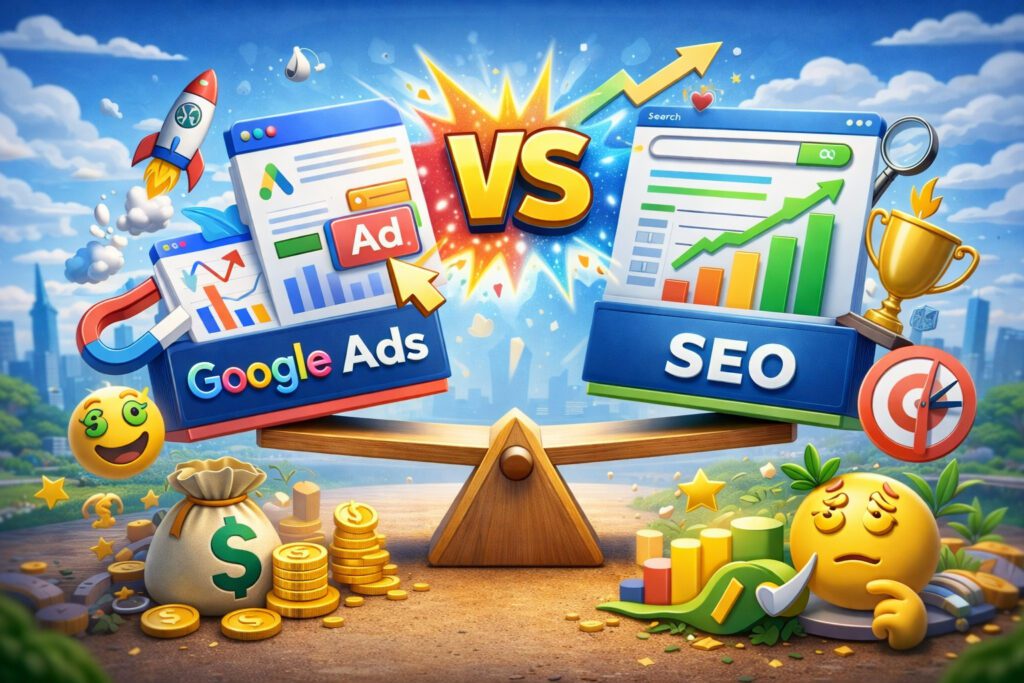
The most common question Kenyan business owners ask when they discover Google Ads is whether they still need SEO. The honest answer is that they serve different purposes and the best approach for most businesses is to run both.
Google Ads delivers traffic immediately. The day you launch a campaign and your budget is approved, your ad can appear at the top of Google. You do not wait months. You do not build anything. You pay and you appear.
SEO builds traffic over time. The first results typically take three to six months to appear. But once you rank organically, the traffic keeps coming without ongoing spend per click. A page ranking on page one of Google for a high-volume keyword generates free clicks every day, month after month, indefinitely.
The practical difference for a Kenyan business is timing and budget. A new clinic in Kilimani that needs patients this month needs Google Ads. A clinic that wants to reduce its advertising spend in two years needs SEO. A clinic that wants both short-term leads and long-term organic growth needs to run both simultaneously.
Google Ads is also the only option for keywords where you have no organic ranking and cannot wait to build one. A new business in Nairobi entering a competitive market cannot wait six months for SEO to take effect. Google Ads buys time while SEO is being built.
There is one situation where Google Ads clearly wins over SEO. When you need to test whether a product or service has commercial viability in Kenya, running a small Google Ads campaign for two weeks is the fastest way to find out. If nobody clicks, the market does not exist or the keyword targeting is wrong. If clicks convert to leads, you have validated the demand before investing months in SEO content.
What Google Ads Can and Cannot Do for Your Business
Understanding the limitations of Google Ads is as important as understanding the benefits. Many Kenyan businesses have wasted significant budgets by expecting Google Ads to do things it cannot.
Google Ads can put your business in front of people who are actively searching for what you offer. A safari company in Arusha running ads for “Tanzania safari 2026” reaches travellers at the exact moment they are planning and comparing options. The intent is as high as it gets in digital marketing.
Google Ads cannot fix a bad product, a weak website, or a broken sales process. If your website loads slowly on mobile, has no clear call to action, and no M-Pesa payment option, a Google Ad that sends traffic to it will generate clicks and nothing else. The ad budget pays for the traffic. Your website converts that traffic into customers. If your website cannot convert, Google Ads will drain your budget with nothing to show.
Google Ads cannot build brand awareness cost-effectively in the way that SEO and social media can. A single click at Ksh 200 from a legal services campaign that does not convert is Ksh 200 lost. A blog post that ranks organically and generates fifty visits per month costs nothing per visit after the initial investment in writing it.
Google Ads requires continuous investment to maintain results. The day you pause your campaign, your ads disappear. There is no residual benefit. A business that runs Google Ads for six months and stops gets nothing from those six months of spend except the leads generated during that period. SEO compounds. Google Ads does not.
How to Set Up a Google Ads Campaign in Kenya
Setting up Google Ads is technically straightforward. Running it profitably requires skill and ongoing attention. Here is the basic process.
Step 1: Create a Google Ads Account
Go to ads.google.com and sign in with a Google account. Set your billing currency to Kenyan Shillings. You can pay via M-Pesa, credit card, or bank transfer. Set up conversion tracking before you spend a single shilling. Without conversion tracking, you will know how many people clicked your ad but not how many of those clicks became leads or sales. Running Google Ads without conversion tracking is like driving at night without headlights.
Step 2: Define Your Campaign Goal
Google Ads asks you what you want to achieve. The options include sales, leads, website traffic, brand awareness, and app downloads. Choose the goal that matches what your business actually needs. A law firm needs leads. A clothing store selling online needs sales. A new Nairobi restaurant wanting to build awareness needs traffic or brand awareness.
Step 3: Choose Your Campaign Type
For most Kenyan businesses starting with Google Ads, Search campaigns are the right starting point. They are the most straightforward to understand and optimize, and they capture the highest-intent searchers. Add Display, YouTube, or Performance Max later once your Search campaigns are profitable and you have the budget to expand.
Step 4: Do Keyword Research
Keyword research for Google Ads in Kenya requires thinking about how your specific customers search. A Nairobi hospital looking for patients does not bid on “hospital” because that is too broad and expensive. It bids on “private hospital Westlands,” “specialist clinic Nairobi,” and specific condition-related searches relevant to its departments.
Use Google’s Keyword Planner, which is free inside your Google Ads account, to see search volumes and estimated costs for the keywords you are considering. Focus on keywords with clear commercial intent, meaning the searcher is ready to buy or enquire, not just learning about a topic.
Negative keywords are equally important. A wedding photographer in Nairobi bidding on “photographer Nairobi” needs to add negative keywords like “salary,” “job,” “course,” and “school” to avoid paying for clicks from people looking for photography jobs or training rather than a photographer to hire.
Step 5: Write Your Ad Copy
A Google Search Ad consists of headlines and descriptions. You can write up to fifteen headlines, each up to thirty characters long, and Google will mix and match them to find the best-performing combinations. You can write up to four descriptions, each up to ninety characters.
Your headlines should include the keyword the person searched for, a clear statement of what you offer, and a differentiator that makes your ad worth clicking over the competitors listed beside it. Your descriptions expand on the headline with more detail, your unique selling point, and a clear call to action.
For Kenyan audiences, including location in your headlines increases click-through rates. “Best Dental Clinic Westlands” outperforms “Best Dental Clinic” because it immediately tells a Westlands searcher that you are nearby.
Step 6: Build a Landing Page That Converts
Sending your ad traffic to your homepage is one of the most common mistakes Kenyan businesses make with Google Ads. Your homepage serves many purposes. A landing page serves one: converting the specific visitor who clicked your specific ad.
A landing page for a Google Ad targeting “immigration lawyer Nairobi” should talk about immigration law, show credentials relevant to immigration cases, have a clear call to action to book a consultation, and make it easy to contact you by phone, WhatsApp, or email. It should not require the visitor to navigate through your full website to find what they were looking for.
On mobile, which is how most Kenyans will arrive, your landing page should load in under three seconds, display properly on a small screen, and have a click-to-call button or WhatsApp link prominently placed. A slow, desktop-designed landing page receiving mobile traffic will produce a high bounce rate and a low Quality Score, which raises your costs and reduces your placement.
Common Google Ads Mistakes Kenyan Businesses Make
The gap between businesses that profit from Google Ads and businesses that waste their budgets on it comes down to a small number of avoidable mistakes.
Using broad match keywords without understanding what they do is the most expensive beginner mistake. Broad match tells Google to show your ad for searches that are loosely related to your keyword. A florist in Nairobi bidding broadly on “flowers” might find their ad appearing for searches like “flower arrangement course” or “flower biology Kenya.” Adding proper match types and negative keywords is one of the first things any competent Google Ads manager does.
Not setting a geographic target means your ads can show to people outside Kenya. A Nairobi law firm paying for clicks from Kampala or Dar es Salaam is wasting money on traffic that cannot become a client. Always restrict your geographic targeting to the areas you actually serve.
Ignoring mobile optimisation in a market where most searchers are on mobile phones makes every click more likely to bounce. If your landing page looks broken on a Tecno or Samsung phone, you are paying for traffic that leaves immediately.
Setting a budget and forgetting about it is how campaigns go wrong silently. A keyword that was generating leads at Ksh 80 per click last month may be costing Ksh 250 per click this month because a new competitor entered the auction. Google Ads requires regular review.
Measuring clicks instead of conversions tells you nothing useful. A campaign generating 500 clicks per month at Ksh 50 per click is spending Ksh 25,000. Whether that is a good investment depends entirely on how many of those clicks became actual leads or customers. Always measure what matters to your business, not what is easiest to measure.
How to Know If Your Google Ads Are Working
Three numbers tell you whether your Google Ads are working or wasting money.
Cost Per Acquisition, or CPA, is how much you pay in total ad spend to get one customer or lead. A clinic spending Ksh 40,000 per month and getting 20 new patient enquiries has a CPA of Ksh 2,000 per enquiry. Whether that is good or bad depends on the value of each patient to the clinic. If an average patient is worth Ksh 15,000 in lifetime revenue, a Ksh 2,000 acquisition cost is excellent. If they are worth Ksh 1,500, it is a loss.
Return on Ad Spend, or ROAS, measures how much revenue you generate for every shilling spent on ads. Google itself reports that businesses earn an average of two dollars in revenue for every one dollar spent on Google Ads globally. In Kenya, where clicks are cheaper, the ratio can be significantly better for well-managed campaigns in the right sectors.
Conversion Rate is the percentage of people who click your ad and then take the action you want, whether that is filling in a form, calling you, or making a purchase. If 100 people click your ad and 5 fill in your contact form, your conversion rate is 5%. Industry averages globally hover around 7 to 8% for Google Search ads. A well-optimised campaign in Kenya with a strong landing page can exceed these benchmarks.
Should You Manage Google Ads Yourself or Hire an Agency?
This depends on your budget, your time, and how competitive your market is.
Managing Google Ads yourself is viable if your budget is under Ksh 20,000 per month, your target keywords are not highly competitive, and you have time to learn the basics and check your campaigns weekly. Google’s own certification courses through Skillshop are free and will teach you the fundamentals. For a small local business in a non-competitive category, self-management is a reasonable starting point.
Hiring an agency makes sense when your monthly budget exceeds Ksh 40,000, your market is competitive, or your previous attempts at running Google Ads did not produce returns. A poorly managed campaign in a competitive keyword environment can burn through a large budget in days. An agency that knows what they are doing typically pays for themselves within the first campaign cycle through better Quality Scores, tighter keyword targeting, and proper conversion tracking.
When evaluating a Google Ads agency in Kenya, ask for case studies showing actual CPA and ROAS results from Kenyan campaigns, not global benchmarks. Ask how often they review and optimise campaigns and what reporting you will receive. Be cautious of agencies that promise specific results before they have assessed your market, your website quality, and your conversion infrastructure.

Google Ads and AI Search: What Is Changing in 2026
Something important is happening to Google Ads in 2026 that most Kenyan businesses have not yet noticed. Google AI Overviews, the AI-generated summaries that now appear at the top of many search results pages, are changing where ads appear and how many clicks reach the websites below them.
Research published in early 2026 found that organic click-through rates dropped significantly on queries where AI Overviews appear. Paid ad click-through rates also declined on these queries. The Seer Interactive research found paid CTR dropped 68% on queries with AI Overviews, falling from 19.7% to 6.34%. Google has responded by beginning to place ads directly inside AI Overviews themselves, and Kenya is among the markets where this is being rolled out.
For Kenyan businesses running Google Ads, this means two things. First, the results you achieved from the same budget in 2024 may require adjustment in 2026 as the search results page continues to change. Second, the businesses that invest in both paid advertising and the content quality needed for AI citation will have a structural advantage over those that do either alone.
The best Google Ads campaigns in Kenya in 2026 are built to complement strong organic content, not replace it. A business that appears in the AI Overview organically and also runs a targeted ad below it occupies two positions on the same page. That combination is the highest-leverage outcome available in Kenyan search marketing right now.
Frequently Asked Questions About Google Ads in Kenya
What is the minimum budget to run Google Ads in Kenya? There is no official minimum. You can start with as little as Ksh 500. But a realistic minimum to gather useful data from a focused campaign is Ksh 15,000 per month. Anything below that and you will not get enough clicks to make meaningful decisions about what is working.
How quickly do Google Ads produce results? Results can appear on the day you launch. Google Ads is the fastest digital marketing channel available in Kenya. However, the first two to four weeks of a new campaign are typically a learning phase where Google’s algorithm is optimising delivery. Expect better performance from week three onwards as the system learns which searches and audiences convert for your business.
Can Google Ads work for a small business in Kenya? Yes, and small businesses in Kenya have an advantage over large competitors in some respects. A focused small budget on a narrow set of highly relevant keywords will outperform a large budget spread thin across broad, expensive keywords. A salon in Westlands spending Ksh 15,000 per month on three hyper-specific keyword phrases will get better returns than the same salon spending Ksh 60,000 on generic beauty keywords.
Do I need a website to run Google Ads in Kenya? You need somewhere to send the traffic. This is typically a website or landing page. Google does allow lead form ads that capture contact details directly inside the ad without requiring a website visit, which can be a useful starting point for businesses without a properly optimised website. But for most campaign types, a fast, mobile-friendly landing page is essential.
What is a good click-through rate for Google Ads in Kenya? The global average click-through rate for Google Search Ads across all industries in 2025 is 6.66%, according to WordStream’s benchmark data. A well-written ad that closely matches the search intent can achieve significantly higher rates. If your click-through rate is below 3%, your ad copy or keyword targeting likely needs attention.
How is Google Ads different from boosting a Facebook post? They target different moments. Google Ads reaches people who are actively searching for something. Boosting a Facebook post reaches people who are scrolling through their feed and not actively looking for anything. Google Ads captures demand that already exists. Facebook and Instagram ads create demand by putting your brand in front of people who may not know you yet. Both have their place in a complete digital marketing strategy.
Is Google Ads worth it for a Kenyan business in 2026? For businesses selling high-value services or products where customers search before buying, Google Ads remains one of the highest-return digital marketing investments available in Kenya. The lower cost per click compared to Western markets, combined with the high commercial intent of Google searchers, creates conditions where a well-managed campaign can generate strong returns. The businesses that struggle are those that run ads without proper conversion tracking, send traffic to poor landing pages, or treat Google Ads as a set-and-forget system rather than one that requires active management.
Google Ads is one of the most powerful tools available to Kenyan businesses that want to generate leads and sales quickly. But it rewards preparation and penalises guesswork. If you want to understand what a properly structured Google Ads campaign looks like for your specific business in Kenya, our Google Ads management services page covers how we approach it for clients across Nairobi and East Africa.