One agency quotes you Ksh 20,000 a month. Another quotes Ksh 100,000 for what sounds like the same thing. Neither explains the gap, and you are left trying to work out whether the expensive one is ripping you off or the cheap one is about to waste six months of your time.
Both are possible. Here is how to tell which is which. What SEO Actually Costs in Kenya??… let’s dive right in
What the Kenyan market actually charges
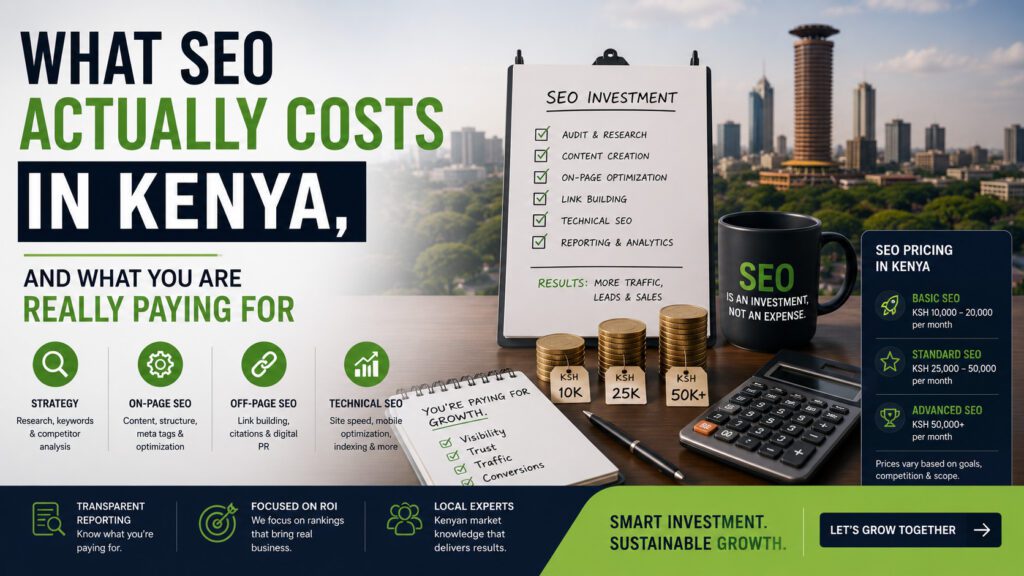
A January 2025 study reviewing 50 SEO providers in Kenya found basic packages averaging KES 41,000 a month, ranging from KES 11,250 to KES 77,700. Advanced packages averaged KES 85,300, ranging from KES 50,000 to KES 150,000. Premium and enterprise work ran from KES 100,000 to KES 500,000.
Those averages are wide enough to be almost useless on their own, which is exactly the problem. The number tells you nothing without knowing what sits behind it.
Our prices, since I am asking you to be sceptical of everyone else’s
Local SEO starts at Ksh 50,000 a month. That covers a business competing within Kenya for local or national search terms.
International SEO and competitive niches start at Ksh 90,000. That is safari and tour operators, hotels and lodges selling to overseas guests, and any business competing against international sites for international traffic.
I will explain below why the second number is nearly double the first, because the reason matters more than the figure.
The five pricing models, not two
Kenyan pricing articles usually mention retainer and project-based work and stop there. There are five models in common use and the one you are offered tells you a lot about the agency.
Monthly retainer. The dominant model globally. A 2025 industry survey found 78.2% of SEO providers use it. You pay a fixed monthly fee for ongoing work. Predictable, suits long-term growth, and it is what most Kenyan businesses should be looking at.
Project-based. A fixed fee for a bounded piece of work. A technical audit. A site migration. A content strategy build. Clear scope, clear deliverable, no ongoing commitment. Good for solving a specific problem, but it does not build compounding results.
Hourly. Appropriate when you are hiring someone to advise rather than execute. Wrong for agency delivery work, because you are buying outcomes, not time. If an agency quotes you hourly for an ongoing campaign, ask why.
Performance-based. Sounds ideal. Rarely is. More on this below.
Hybrid. A base retainer plus performance bonuses tied to specific outcomes. The most sensible version of performance pricing, and increasingly the standard for larger engagements.
What is not in the retainer
This is the single biggest gap between what Kenyan businesses expect and what they receive, and almost nobody writes about it.
When an agency quotes you a monthly figure, ask specifically whether it includes content production and link building. Very often it does not. International analysis of this pattern found that a retainer quoted without content production typically ends up 50% higher in practice once content is billed separately.
The same thing happens here. A Ksh 40,000 quote that excludes content becomes Ksh 60,000 by month three, because content is not optional. Google needs pages to rank and you cannot build topical authority without publishing.
Ask for the exclusions list before you sign anything. A proposal that only lists what is included is telling you half the story.
Hidden costs that inflate the first year
Analysis of SEO contracts internationally found that setup fees and tool subscriptions commonly inflate year-one spend by 30% to 50% above the quoted monthly figure.
Watch for one-off onboarding or setup fees, tool and software costs passed through to you, content production billed per piece, link building or digital PR billed separately, and reporting dashboard subscriptions.
None of these are inherently dishonest. Tools genuinely cost money. Ahrefs and Semrush run several hundred dollars a month and no serious agency works without them. The problem is when they appear on an invoice you were not expecting.
The question to ask is simple. What will I actually pay in month one, and what will I actually pay in month twelve? If those two numbers are different, you want to know why before you commit.
Why performance-based pricing is usually a trap
On the surface it is the fairest possible arrangement. You pay when it works.
In practice it breaks down for a reason that has nothing to do with anyone’s integrity. SEO takes three to six months minimum before meaningful movement. Under a pure performance deal, the agency does months of unpaid work, and by the time results appear, both parties have an incentive to argue about attribution. Was it the SEO, or the new website, or the seasonal uplift, or the competitor who went quiet?
One documented case had an agency complete around KES40,000 of work before seeing payment, then lose the attribution argument entirely.
The second problem is worse for you. An agency paid on rankings will chase rankings, and rankings are trivially easy to win on keywords nobody searches. You end up ranking first for phrases that generate no enquiries, and technically the agency delivered.
If you want performance in the deal, structure it as a hybrid. A base retainer covering roughly 60% to 70% of a standard fee, plus bonuses tied to outcomes that actually matter. Qualified leads. Organic revenue. Traffic from buyer-intent terms you agreed on in advance.
An agency offering guaranteed rankings with no base fee is either inexperienced or has already decided which meaningless keywords to target.
Why competitive niches cost nearly double
Back to the Ksh 50,000 versus Ksh 90,000 gap.
If you run a tour company, a lodge, or a hotel selling to international guests, you are not competing with other Kenyan businesses. You are competing with operators who have backlinks from the Guardian and Condé Nast Traveller, and with international travel publishers who have been building authority for fifteen years.
A single quality backlink in the travel and hospitality space costs between $100 and $200. Ksh 13,000 to Ksh 26,000. For one link. Building genuine authority in that space needs several every month, sustained over a year, alongside content production and technical work.
Do that arithmetic against a Ksh 35,000 monthly retainer and you can see what is possible. You are paying for a monthly report, some meta description edits, and light maintenance. Nothing in that budget touches the actual competitive gap.
This is not an argument that expensive is better. It is an argument that price has to match the difficulty of the job. Ksh 50,000 is genuinely enough for a Nairobi business competing locally. It is not enough for a Serengeti operator competing against &Beyond.
What has changed in 2026
Two things worth pricing in.
Content quality standards have tightened considerably through Google’s recent updates. Approaches that used to work cheaply, scaled AI content without oversight, low-quality link buying, keyword stuffing, now carry real penalty risk. The cheap tactics are not just less effective than they were. They are actively dangerous.
And AI search has arrived faster in Kenya than in most markets. Reporting on DataReportal’s 2025 data suggests Kenya has among the highest ChatGPT adoption rates globally, with a substantial share of Kenyan internet users engaging with it monthly. Whatever the exact figure, the direction is clear enough that visibility in AI-generated answers is no longer a future concern here. It is a present one, and any 2026 proposal should account for it.
How to read a proposal
Six questions that will tell you more than any price comparison.
Did they audit your site before quoting? A generic package with no diagnostic is a package, not a strategy.
What exactly is excluded? Content, links, tools, setup.
What will month twelve cost, not month one?
What do they report on? If it is impressions and rankings rather than leads and revenue, ask why.
Can they show Kenyan results? International case studies tell you little about this market’s competition levels and domain authority landscape.
Do they understand your specific niche? For travel, hospitality, law, and other competitive verticals, generic SEO experience is not enough.
The short version
Below roughly Ksh 40,000 a month, you are usually buying activity rather than outcomes. That may be fine for a micro-business in a quiet niche.
Between Ksh 50,000 and Ksh 90,000 you can run a real campaign for a business competing within Kenya.
Above Ksh 90,000 is where competitive and international work becomes viable, because that is the point at which the link and content budget can actually close the gap.
The most expensive decision available to you is paying a small retainer for two years and then starting again with someone competent. You lose the money, the time, and sometimes the site’s credibility along the way.
Spend properly or wait until you can. Both are better than spending badly.