Local search is undergoing its most significant transformation in a decade. While traditional SEO focused on ranking in Google’s local pack, businesses now face a fundamentally different challenge: appearing in AI-powered search results across multiple platforms.
Analysis reveals that AI local packs now appear for approximately 8% of tracked local search keywords, with that percentage growing consistently. More concerning, according to Joy Hawkins at Sterling Sky, these AI-powered results are completely replacing traditional local packs, not appearing alongside them.
The businesses adapting to this shift are implementing systematic strategies across four critical pillars. Here’s exactly what’s working.
Understanding the New Local Search Landscape
Traditional local search operated predictably. Users typed “plumber near me” into Google, received a map pack showing three businesses with prominent call buttons, and made contact.
That model is obsolete.
Modern search behavior has evolved toward conversational queries. Research from One Base Media demonstrates how users now ask “Who are the best plumbers in Essex?” or “Recommend me the best personal injury lawyers in Chesterfield, Missouri.” These natural language queries trigger AI-generated responses that fundamentally change visibility dynamics.
Google’s AI overviews now appear at the top of search results for these conversational queries, pulling specific examples of highly-rated businesses. Instead of seeing three businesses in a map pack, users encounter AI-generated recommendations that prioritize different businesses based on different criteria.
The impact extends beyond Google. ChatGPT, Perplexity, Claude, and other AI platforms are increasingly serving as discovery tools for local services. When users ask these platforms for recommendations, they generate comprehensive lists drawn from diverse sources across the web.
Joy Hawkins and her team at Sterling Sky, working with data from Places Scout, analyzed local search patterns and revealed the magnitude of this shift. AI local packs surfaced 5,943 unique businesses compared to traditional local packs which surfaced 18,330 businesses for the same queries. This represents a 68% reduction in the number of businesses gaining visibility through local search results.
In 322 analyzed markets, 88% showed fewer unique businesses appearing in AI local packs compared to traditional formats. As Hawkins notes, “Even the businesses that still rank well in the local pack are seeing deterioration in calls.”
Identifying Your True AI Competitors
The businesses ranking well in traditional local pack results may not be your primary competitors in AI search. Understanding who actually appears in AI-generated recommendations requires systematic analysis.
Nathan Gotch at Rankability has developed a methodology for identifying true AI competitors. Start by converting traditional keywords into natural language queries. Tools like Rankability’s AI search query generator transform seed phrases like “personal injury lawyer Chesterfield Missouri” into conversational prompts like “Who are the best personal injury lawyers in Chesterfield, Missouri?”
Run these natural language queries across multiple AI platforms: Google AI mode, Google Gemini, ChatGPT, Perplexity, Grok, and Claude. For each platform, capture two critical data points: the citations or sources the AI references, and the specific brands mentioned in the AI-generated answer.
Create a tracking spreadsheet with two tabs: citations and answers. The citations tab records every URL that AI platforms use as sources. The answers tab tracks which businesses get recommended, their position in the answer, and which platform recommended them.
As Gotch explains, analysis of this data reveals competitive patterns that traditional rank tracking misses entirely. In legal services queries, approximately 40% of citations came from directories while 60% came from actual law firm websites. The brands appearing most frequently across platforms and in the best positions represent your true AI competitors.
This competitive intelligence is actionable. The domains appearing most frequently in citations are the directories and platforms you must prioritize. The businesses dominating AI recommendations reveal the optimization strategies that are actually working.
The Foundation: Google Business Profile Optimization
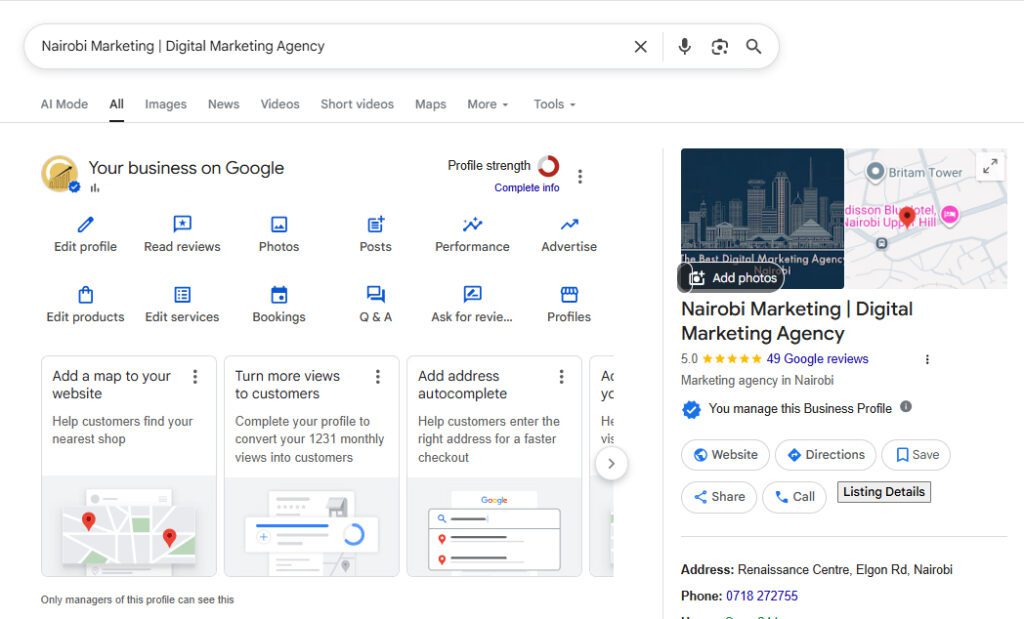
Despite the proliferation of AI platforms, Google remains the dominant search engine for local queries. Strong Google Business Profile performance correlates directly with visibility in Google AI mode and Google Gemini.
Gotch’s analysis shows businesses ranking first in Google’s local pack consistently appear in top three recommendations in Google AI mode. The relationship isn’t absolute, but Google Business Profile optimization remains the foundation of local AI visibility.
Execute these fundamentals rigorously:
Location and category precision. Establish a physical address in your target city. Select the most accurate primary category by examining top-ranking competitors. For personal injury lawyers, “Personal Injury Attorney” consistently outperforms generic “Lawyer” or “Attorney” categories.
Entity-optimized business descriptions. AI systems extract entities (people, places, organizations, concepts) to understand associations. Ambiguous descriptions create poor performance across both traditional and AI search.
As Gotch emphasizes, “Ambiguity is the enemy of search visibility.” A properly optimized description for a personal injury lawyer might read: “John Doe is a top personal injury lawyer in Chesterfield, Missouri specializing in car accidents, medical malpractice, and slip and fall cases.” This clearly establishes the relevant entities: the person, their profession, their location, and their specializations.
Use this standard description consistently across all platforms. Inconsistent business names, addresses, phone numbers, or descriptions create entity ambiguity that reduces visibility.
Obsessive review generation. The correlation between review volume and AI visibility is undeniable. Businesses with exceptional review profiles dominate AI recommendations across platforms.
One Base Media’s case study of TM Hughes and Sons, a plumbing company in Essex, demonstrates this principle. The company appears prominently in both Google AI overviews and ChatGPT recommendations, driven largely by their comprehensive review presence across multiple platforms including Checkatrade, Trustpilot, and Google.
Build review generation into company culture. As Gotch recommends, create internal competitions offering bonuses to employees who generate the most five-star reviews monthly. He cites Four Seasons Heating and Cooling as an example of obsessive review generation done right. Make the review process frictionless for customers by providing direct review links via text message or QR codes.
Google provides a shareable review link for every business profile. Generate QR codes linking directly to your review form using free tools like Canva, then display these codes prominently in physical locations and post-service communications.
The businesses winning in AI search typically maintain 200+ Google reviews with ratings above 4.5 stars.
Building Your Directory Footprint Strategically
Google Business Profile optimization influences Google’s AI products strongly, but has minimal impact on ChatGPT, Claude, Perplexity, or other third-party AI platforms. Businesses dominating Google AI mode while remaining completely invisible in ChatGPT recommendations demonstrate this reality clearly.
Comprehensive directory presence creates the cross-platform visibility that AI systems require. The citations data collected during competitive analysis reveals exactly which directories matter.
As One Base Media’s research shows, when examining why TM Hughes and Sons appeared so prominently in AI search results, the answer was clear: the company maintained optimized profiles on Checkatrade, Water Safe, Trustpilot, Yelp, and MyBuilder. These platforms represent the consensus sources that AI products reference repeatedly.
For legal services, Super Lawyers, Avvo, Justia, and niche local directories consistently appear as citation sources. For home services, Checkatrade, Trustpilot, Yelp, and MyBuilder dominate citation patterns.
Systematic directory optimization requires more than basic listings. Apply SEO best practices to every profile:
Location-optimized profile descriptions. Craft unique descriptions for each directory that incorporate target city names and service specializations naturally. As Gotch recommends, use AI tools like Rankability to analyze top-ranking competitor profiles and identify the entities and topics to cover.
Review diversity strategy. Allocate 80% of review generation efforts toward Google, with the remaining 20% distributed across the most critical directories identified in citation analysis. This creates the review diversity and consensus that guarantees AI platform visibility.
Profile completeness and maintenance. Fully completed profiles with current information, professional photos, service lists, and regular updates outperform skeletal listings consistently. Many directories offer free basic listings that provide substantial AI visibility value even without paid premium features.
One Base Media makes a critical point about directory strategy: many local businesses sign up for platforms like Checkatrade or Trustpilot, and when they don’t generate immediate direct leads, they abandon them. However, even platforms that don’t send direct traffic remain massively valuable because AI tools crawl these sites when generating recommendations.
The directory optimization mistake most businesses make is abandoning platforms that don’t generate immediate direct leads. Directory value in an AI-driven search environment comes primarily from citation authority, not direct traffic. Platforms that send zero direct leads may still be critical for AI visibility if they appear frequently in AI platform citations.
Traditional SEO Still Drives AI Visibility
Approximately 60% of citation sources in local AI search results come from ranking websites rather than directories. Businesses achieving top eight positions in traditional organic search for target queries consistently appear in AI-generated recommendations.
Gotch’s research confirms the relationship is straightforward: ranking in classic organic search remains one of the strongest methods for influencing AI answers when AI systems use retrieval-based responses. In his analysis, all five law firms with the best visibility in AI were also ranking in the top eight in Google’s traditional search results.
Content optimization for AI and traditional search. Commercial service pages require entity-based optimization. For a personal injury lawyer, this means dedicated pages targeting specific practice areas (car accidents, medical malpractice, slip and fall) plus target city.
Tools like Rankability analyze top-ranking competitors to extract the entities those pages cover comprehensively. As Gotch explains, “The better you cover these relevant entities on your page, the more search engines and AI platforms will understand it. Clarity and relevance is a precursor to rankings.”
Beyond commercial pages, create localized topical authority through supporting content that demonstrates geographic expertise. Gotch advises avoiding generic content like “What is medical malpractice” that every site has already created and AI can easily answer. Instead, create location-specific content like “The most significant medical malpractice cases in Chesterfield, Missouri in the last 10 years” or “Chesterfield car accident statistics and injury claim implications” that establishes genuine local authority.
Technical requirements for AI crawlability. AI systems struggle with JavaScript-heavy websites. Prioritize HTML-driven architecture. As Gotch notes, “AI doesn’t render JavaScript,” making HTML-driven sites essential for retrieval.
Ensure every page is crawlable, indexable, and retrievable by both search crawlers and AI platforms. Use Rankability’s free AI search indexability checker to verify your site meets these requirements. Verify mobile responsiveness, implement SSL certificates, use strategic internal linking, and maintain site architecture where no page sits more than three clicks from the homepage. Website speed directly impacts both traditional search rankings and AI retrieval probability.
Link building for local authority. Local businesses should prioritize sponsorships and donations to local organizations, brand mentions in local news, and links from business associations or chambers of commerce.
Gotch provides a practical framework: use AI tools to identify these opportunities systematically. Using ChatGPT’s agent mode with appropriate prompts generates comprehensive lists of local sponsorship opportunities, relevant local organizations, and potential partnership targets.
Expand beyond pure link building into PR-style opportunities using platforms like Featured, HARO, and Quoted to provide expert commentary. For businesses where the owner isn’t the primary expert, Gotch recommends interviewing subject matter experts, recording and transcribing conversations, then uploading this knowledge to AI projects to generate expert responses in the appropriate voice.
The Listicle Strategy That’s Working Now
One particularly effective tactic emerging from practitioner testing involves strategic use of listicles. As demonstrated by Jacky Chou at Local Rank Tracker, listicles are proving highly effective for AI visibility.
Chou’s testing with AB Newswire press releases shows that even after Google began filtering obvious listicle formats, modified approaches still achieve strong results. His case study publishing “Best SEO Companies in Vancouver, BC, Canada” through AB Newswire achieved indexing and visibility across multiple AI platforms within 27 minutes of publication.
The key modifications that worked: maintain “best [keyword]” phrasing in titles, but avoid obvious numbered list formats in the main description. The goal is securing the “best” keyword in the title while presenting information in a more editorial format that passes through filters.
As Chou emphasizes, “TLDR: citations plus listicles, you should be okay.” His testing confirms that businesses mentioned in multiple listicle-style articles across the web see significantly improved AI visibility, particularly in ChatGPT and Perplexity results.
Chou’s live testing demonstrated impressive results across multiple platforms. When searching “best SEO companies in Vancouver” variations, his press release appeared in:
- Traditional Google search results with bar chart features
- Google AI mode recommendations
- Multiple keyword variations within hours of publication
The practical application involves creating or commissioning content that positions your business favorably in “best of” comparisons, then distributing this through press release services and syndication networks. Chou’s methodology generates both traditional search visibility and AI platform citations rapidly.
Measuring What Actually Matters
Traditional rank tracking tools cannot identify AI local pack appearances, creating dangerous blind spots. Businesses review ranking reports showing stable positions while actual visibility deteriorates.
Monitor these alternative metrics:
Call volume from Google Business Profiles remains the most reliable indicator. As Joy Hawkins’s data demonstrates, month-over-month declines during otherwise stable periods signal format changes affecting visibility. “Even the businesses that still rank well in the local pack are seeing the deterioration in calls,” Hawkins notes.
Her analysis of 179 Google Business Profiles across 34 law firms shows a dramatic drop in call volume over the past year, with the steepest declines occurring as AI local pack rollout accelerated.
Click-through rates from Google Search Console reveal whether users engage with your search presence regardless of format. Declining CTR despite stable rankings indicates visibility problems.
AI platform testing. Manually run target queries through ChatGPT, Perplexity, Google AI mode, and Claude monthly. Track which businesses appear in recommendations and in what positions. Gotch’s methodology using bookmark scripts to capture citations provides a systematic approach for this tracking.
Citation diversity metrics. Monitor how many different directories and platforms cite your business. Broader citation footprints correlate with more consistent AI visibility.
The Uncomfortable Reality and What Comes Next
The local SEO playbook that worked for the past decade is obsolete. Rankings without visibility generate no value. Visibility without call buttons generates fewer conversions.
Google is not obligated to maintain formats that businesses have relied upon. AI local packs likely perform well for Google’s objectives: they provide quick answers, reduce spam, and create commercial pressure driving advertising revenue.
For local businesses, the era of free, high-converting visibility from Google Business Profiles is ending. As Hawkins warns, “These AI powered packs are not in addition to local packs. They are completely replacing them.”
The current state of AI local packs presents four major challenges for local businesses:
First, AI local packs typically show only two businesses instead of the three that traditional local packs displayed. This immediately reduces visibility opportunities by 33%.
Second, call buttons are absent entirely from AI local packs. Users must click through to the business listing, locate contact information, then initiate calls manually. Each additional friction point reduces conversion rates significantly.
Third, AI local packs often feature different businesses than what appears in traditional local pack results for the same query. This means businesses can maintain strong traditional rankings while becoming invisible in AI-powered results.
Fourth, most rank tracking tools cannot identify or measure AI local pack appearances yet. As Chou notes, “AI local SEO is officially coming. The writing was on the wall, but they finally started testing it on desktop.” Businesses reviewing ranking reports see stable positions while actual visibility quietly deteriorates.
The businesses adapting successfully are those accepting this reality and implementing systematic responses: comprehensive directory presence, review generation across platforms, traditional SEO fundamentals, and strategic paid advertising where organic visibility contracts.
Hawkins’s data reveals that clients running Google Ads are achieving better ROI compared to before. “Why? Because ads still have call buttons and better placements while organic listings are losing both.”
Her recommendation is blunt but necessary: “If you’re relying on a single high-ranking Google Business Profile, you can expect less calls in 2026. That’s pretty much a guarantee.”
The strategic response involves geographic expansion through multiple locations, comprehensive paid search integration across all Google ad formats, and building alternative discovery channels beyond Google Business Profiles entirely.
The question isn’t whether AI will dominate local search. The data confirms it already does. The question is whether your business will adapt before visibility decline becomes a revenue crisis.