The Red Card Files: Disinformation and Dirty Political Tactics in Kenya, and How to Spot Them
Disinformation in Kenyan politics, exposed: fake polls, bulk SMS, cash giveaways, bot networks, deepfakes and misused voter data. How each tactic works, how it gets caught and how voters can spot it.
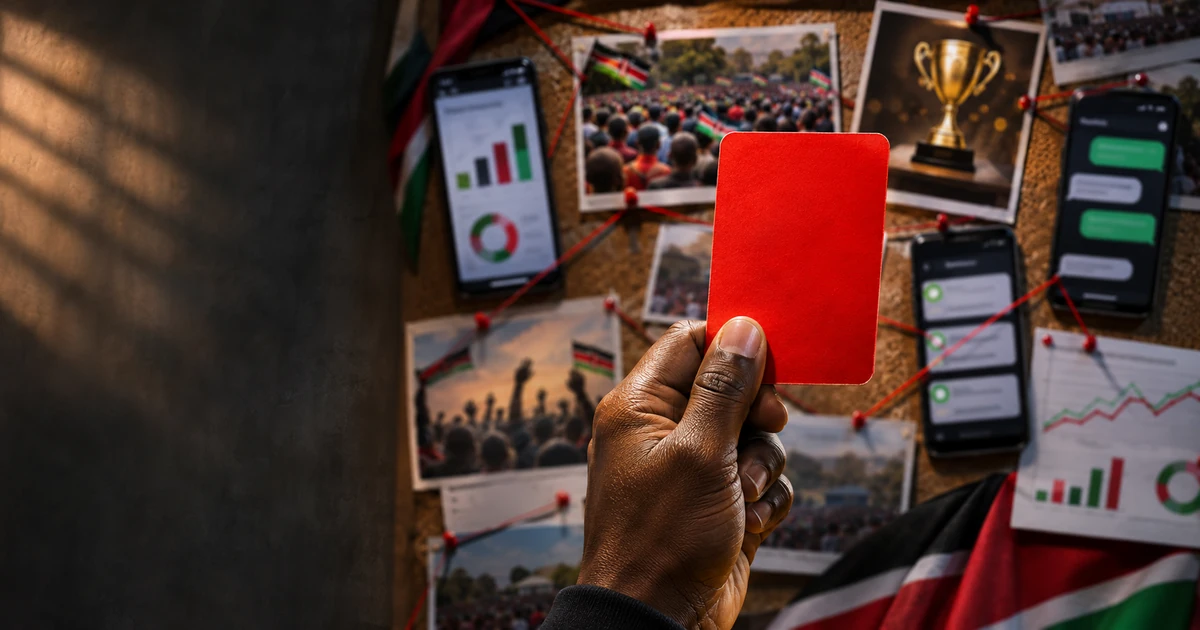
Disinformation in Kenyan politics rarely looks like a lie. It looks like an opinion poll with a famous logo, an SMS from a number you have never saved, a TikTok ‘resident’ praising roads you have never seen, or a clip of a leader saying something he never said. Kenya’s 2027 General Election is on 10 August 2027, and the election period has been legally open since 20 August 2026. These are the Red Card Files: the dirty tactics every Kenyan voter will meet between now and polling day. For each one we cover what it is, why campaigns use it, real cases, how it gets caught and what happens next.
This playbook covers Fair Play, Yellow Card and Red Card tactics for educational purposes only. Nairobi Marketing does not provide services to political candidates, parties or campaigns, and has no affiliation with any candidate or party. See the full disclaimer below.
This article is part of our series Political Campaign Digital Marketing in Kenya: The 2027 Playbook. If you are new to the series, start there for the full map.
How to Read the Red Card Files
Every tactic in this series gets a card:
- 🟢 Fair Play (Siasa Safi) Legal, platform-compliant and honest with voters.
- 🟨 Yellow Card (Siasa za Ujanja) Bends platform rules or exploits loopholes. Common, effective and risky.
- 🟥 Red Card (Siasa Chafu) Deceives voters or breaks the law.
Every Yellow and Red Card gets a verdict on ‘Can they get away with it?’: Often (rarely enforced), Sometimes (depends on scale and scrutiny) or Rarely (increasingly detected and punished). Then we explain what happens if caught.
We explain Red Card tactics so you can recognise them, not so anyone can copy them. There are no step-by-step instructions here and no tool or vendor names.
One timing note matters for this whole article. Until August 2026, some of these tactics sat in a legal gap. A 2025 High Court judgment found there was no law to act on campaign violations outside the election period. That gap closed when IEBC Gazette Notice No. 13497 of 20 August 2026 opened the election period and brought the Electoral Code of Conduct and the Election Offences Act into force. Tactics that were Yellow before that date are now Red. The full legal picture is in Election Laws Kenya 2027: Rules for Digital Campaigns.
The Red Card Files at a glance
| Tactic | Worst card | Can they get away with it? |
|---|---|---|
| Fake or bent opinion polls | 🟥 | Sometimes |
| Staged street vox pops | 🟥 | Often |
| Bought or self-made awards | 🟥 | Often |
| Fake independent front groups | 🟥 | Sometimes |
| Fake testimonials and AI faces | 🟥 | Sometimes |
| Bulk SMS from untraceable lines | 🟥 | Often |
| Cash giveaways and ‘weekly winners’ | 🟥 | Rarely, once it’s filmed |
| Manufactured engagement | 🟥 | Sometimes |
| Bot and sockpuppet networks, paid hashtags | 🟥 | Sometimes |
| Deepfakes and cloned voices | 🟥 | Rarely, at scale |
| Misused voter data | 🟥 | Often |
| Staged charity cases | 🟥 | Sometimes |
1. Opinion Polls in Kenya: Real, Bent and Fake
Opinion polls in Kenya do more than measure the race. They shape it. A candidate who ‘leads’ attracts donors, defectors and the bandwagon voter who does not want to waste a vote. That is exactly why polls are a favourite target for disinformation.
🟢 Fair Play Published methodology
A credible poll tells you who ran it, who paid for it, how many people were asked, how they were reached, when, and the margin of error. Kenya’s Opinion Polls Act exists to make that kind of disclosure the norm for election polls. Campaigns also run private internal polls to decide where to spend time and money. That is normal and useful, as long as they don’t publish them as independent research.
🟨 Yellow Card The bent poll
A poll can be registered, real and still bent. The common levers are:
- Wording: ‘Given the rising cost of living, who would you vote for?’ primes a different answer than a neutral question.
- Sampling: too many respondents from one region, age group or phone network.
- Timing: fieldwork done the week after a big rally in one candidate’s stronghold.
- Selective release: commission five polls, publish the two that look good.
- Undecided handling: how the ‘don’t knows’ are shown or shared out can move a headline by several points.
Can they get away with it? Often. None of these levers is illegal on its own, and most voters only see the headline graphic.
What happens if caught: reputational damage to the pollster and the campaign, rival media picking apart the methodology, and a credibility problem that follows the brand into the next election.
🟥 Red Card Fake pollsters, flooded online polls and blackout breaches
The Red Card versions are simpler and more common than most people think:
- Fake polls carrying real logos. In March 2022, a ‘Machakos gubernatorial opinion poll’ carrying TIFA’s logo spread on Facebook. TIFA publicly called it fake. Another graphic using TIFA branding for Laikipia was also debunked by Africa Check. In the 2026 Ol Kalou by-election, Infotrak disowned a poll circulating with its branding. In May 2026, an AI-generated poll graphic claimed 80% popularity for the President ahead of 2027.
- Pollsters that don’t exist. A new ‘research firm’ with a smart name, no address, no track record and no published methodology appears a few months before an election, publishes one dramatic poll, then disappears.
- Flooded online polls. A ‘Who should be Governor?’ poll on a Facebook page or X is not a survey. Whoever has the most organised WhatsApp groups wins it, and the screenshot then gets shared as if it means something.
- Publishing in the blackout. The Opinion Polls Act bars publishing election polls on election day and in the five days before. Breaking it can bring a fine of up to KES 1 million, up to a year in jail, or both. For 2027, the last day to publish is around 4 August.
Why campaigns use it: bandwagon psychology. People like to back a winner, and a ‘leading’ candidate finds fundraising, endorsements and media attention easier.
Real cases: the fake-logo cases above. They are documented, debunked, and they keep coming back every cycle.
How it gets caught: the named pollster disowns it, usually within hours. Fact-checkers look for the poll on the firm’s official website and social accounts. If it isn’t there, it isn’t real. Graphics with wrong fonts, rounded totals over 100% and no sample size are giveaways.
Can they get away with it? Sometimes. The fake travels fast and the correction travels slowly. But the pollsters whose logos get stolen now respond quickly and publicly.
What happens if caught: public exposure, fact-check labels and reduced reach on Facebook, possible prosecution for blackout breaches under the Opinion Polls Act, and possible defamation or trademark action by the pollster whose brand was used.
A lesson from 2022: even honest polls can miss
In the final round before the 2022 blackout, three of the four big pollsters had Raila Odinga ahead. TIFA’s last poll (31 July to 1 August) had him on 49% to William Ruto’s 41% including undecided voters, or 53% to 45% excluding them. Infotrak had Raila about seven points ahead and Ipsos had him on 47% to Ruto’s 41%. Only Radio Africa had Ruto ahead, by about 1.3 points. The result was Ruto 50.49% (7,176,141 votes) and Raila 48.85% (6,942,930).
That miss does not prove anyone was cheating. TIFA itself warned that turnout decides elections and that surveys cannot predict it. The lesson for voters is simpler: a poll is a snapshot with an error margin, not a result. And when a camp that is behind calls every poll ‘cooked’, that is a claim, not evidence.
Voter tip: before you share a poll graphic, check whether it appears on the pollster’s official website or verified accounts. If it doesn’t, don’t share it.
2. Street Vox Pops: Who Is Really Speaking?
The street vox pop is now a core part of Kenyan political content: a vlogger with a mic in a matatu stage or market asking ‘Mtapigia nani kura?’, cut into 30-second reels.
🟢 Fair Play Listening tours. The candidate or team asks open questions in different places, including where they are weak, and shows the criticism along with the praise. Done honestly, it is one of the most powerful formats in the playbook.
🟨 Yellow Card Cherry-picked or stronghold-only vox pops, leading questions (‘Si unaona kazi amefanya?’), and ‘independent’ vloggers who are quietly paid by a campaign. The Media Council of Kenya’s 2027 guidelines require disclosure when creators share election messages for payment.
Can they get away with it? Often. Editing choices are hard to prove and most viewers never ask where the clip was shot.
What happens if caught: the vlogger loses credibility, the clip gets stitched and mocked, and undisclosed payment can draw MCK attention.
🟥 Red Card Staged or paid respondents presented as random passers-by, the same ‘resident’ appearing in different towns, and AI dubbing that puts words in a real person’s mouth or swaps a vernacular answer for a translated one that says something else.
Why campaigns use it: vox pops look like the voice of the people, which is the most persuasive kind of social proof there is.
How it gets caught: viewers recognise the same faces across clips, and locals spot the wrong landmarks. Respondents themselves sometimes post ‘they paid me Sh500 to say that.’ With dubbed clips, lips don’t match words, or the audio sounds too clean for a noisy street.
Can they get away with it? Often for staged answers, because nobody checks. Sometimes for AI dubbing, because the person who was dubbed usually finds out and complains loudly.
What happens if caught: public ridicule and loss of trust. A dubbed person can bring a defamation claim, and an altered clip that spreads hate can lead to NCIC action, since digital posts carry the same consequences as public speeches.
3. Awards, Honours and the Bought Certificate
‘Best Performing Governor in East Africa 2026.’ ‘Outstanding Youth Leader Award.’ Kenyan politicians collect trophies, and campaigns post them as proof of delivery.
🟢 Fair Play Merit awards from credible bodies with published criteria and independent judges. Mzalendo’s BungeMeter scorecards are a better example of independent assessment than most trophies, because the data is public.
🟨 Yellow Card Pay-to-attend awards: a gala that ‘nominates’ a leader, then sells the table, the sponsorship package and the photo opportunity. A Citizen Digital opinion piece argued that many accolades politicians display are bought, and that they should be declared as paid publicity. Even state honours have drawn questions: former Kiambu governor William Kabogo said he was once told he needed to pay for his medal.
Can they get away with it? Often. Buying a ticket to an award dinner is not illegal.
What happens if caught: the award becomes a meme, and rivals use it as evidence that the record is thin.
🟥 Red Card Self-created or outright bought awards: an ‘awards body’ set up by allies, with a website registered a month earlier, created to hand the candidate a trophy that is then presented to voters as independent recognition.
The fake-degree parallel: it is the same trick as a fake certificate. In 2022, several governor aspirants faced complaints over allegedly fake degrees, because the law requires a degree for that office. A bought award is a fake credential for performance, just as a fake degree is a fake credential for qualification.
How it gets caught: check the awarding body’s domain age, past winners, judges and criteria. If every past winner is a politician who was in the same room on the same night, you have your answer.
Can they get away with it? Often. Few journalists bother to investigate an awards body unless it becomes a big story.
What happens if caught: embarrassment, rival ‘receipts’ content, and a lasting question mark over every other claim the campaign makes.
4. Front Groups: ‘Friends of X’ and Fake Independent Organisations
🟢 Fair Play Real endorsements from real organisations: a boda boda SACCO, a women’s chama or a farmers’ cooperative that publicly backs a candidate after members vote on it.
🟨 Yellow Card ‘Friends of X’, ‘Youth for X’ and ‘Concerned Citizens of Y Ward’ pages run by the campaign but presented as spontaneous fan movements.
Can they get away with it? Often. Fan pages are normal, and only the deliberate hiding of who runs them crosses the line.
What happens if caught: the page loses credibility, and any ads it runs may break Meta’s political ad rules on verification and ‘paid for by’ disclaimers.
🟥 Red Card Fake independent organisations: a ‘civil society network’, ‘residents’ association’ or ‘think tank’ invented to issue press statements praising one candidate or attacking another, with no members, no office and no history.
Why campaigns use it: a message from a neutral-sounding group is more persuasive than the same message from the candidate.
How it gets caught: on Facebook, open the Page Transparency section and look at the creation date, past name changes and where the managers are based. A ‘Nyeri residents’ page managed from somewhere else, or a ‘civic’ page that was a football fan page last year, is a red flag. We explain warmed-up pages in Influencer Marketing in Kenyan Politics: Podcasts and More.
Can they get away with it? Sometimes. Small fronts slip through, but networks of them get flagged by platforms and researchers.
What happens if caught: platform takedowns for inauthentic behaviour, media exposure, and defamation risk if the front group’s statements make false allegations.
5. Testimonials: Paid Voices and People Who Don’t Exist
🟢 Fair Play Real beneficiaries, filmed with their consent, saying in their own words what changed: the borehole, the bursary, the market shed.
🟨 Yellow Card Paid testimonials without disclosure, such as a popular comedian or musician ‘spontaneously’ praising a governor after a quiet payment. The MCK 2027 guidelines require disclosure when creators are paid for election messages.
Can they get away with it? Sometimes. Leaked briefs and identical wording across several creators give the game away.
What happens if caught: backlash against both the creator and the candidate, and possible MCK attention.
🟥 Red Card Fake residents and AI-generated faces: ‘Mama Wanjiru from the ward’ who never existed, a photo generated by AI, or a real stranger’s photo lifted from the internet with a made-up quote underneath.
How it gets caught: reverse image search finds the original photo. AI faces often have odd earrings, warped backgrounds, strange teeth or hands. Locals simply say ‘huyu si wa hapa.’
Can they get away with it? Sometimes. One fake face slips through, but a series of them rarely survives a curious ward.
What happens if caught: ridicule and lost trust. If a real person’s photo was used, they can complain to the ODPC or sue. And it gives rivals the perfect line: ‘they had to invent their supporters.’
6. Bulk SMS Kenya: Messages From Numbers You Don’t Know
If you live in Kenya, you’ve had them. ‘VOTE FOR…’ from a number you never saved, sometimes at 9pm, sometimes in a language you don’t speak, from a candidate in a ward where you don’t even vote. In 2022, members of KICTANet’s public mailing list swapped stories of these messages and asked where candidates were getting their numbers.
🟢 Fair Play The consented list
The clean version is the lead-magnet list we describe in the pillar playbook: voters sign up for a polling station finder, manifesto download or town hall alert, give clear consent and can opt out easily. Political canvassers must register with the ODPC, and the ODPC has published a Guidance Note for Electoral Purposes. The Communications Authority’s political messaging guidelines also bar sending unsolicited bulk political messages to people who have not opted in. They also limit bulk political content to English and Kiswahili.
🟥 Red Card Untraceable lines and bought contact lists
What it is: instead of a registered sender ID through a licensed provider, messages go out from ordinary personal lines. Some are registered in other people’s names, and the messages are pushed through cheap consumer bulk-messaging apps. The numbers usually come from bought or leaked contact lists, not from anyone who signed up.
Why campaigns use it: it is cheap, it avoids the vetting that licensed providers apply to political content, and when people complain there is no clear sender to blame.
Real cases: complaints about unsolicited political texts go back to at least 2017, when bulk targeted SMS surged. They returned in 2022, the first general election held under the Data Protection Act.
How it gets caught: recipients screenshot the message and report it. Network operators trace and block the line, and the ODPC can investigate how the sender got the data.
Can they get away with it? Often. For one recipient, suing a campaign over a single SMS is not worth the time, and the line is often dead by the time anyone looks. But the commercial cases show complaints can win. The ODPC ordered Goodtimes Africa to pay KES 700,000 to one Kenyan over promotional messages, and Platinum Credit was ordered to pay Sh400,000. Smaller awards have run from KES 20,000 to 50,000. No political-SMS ruling has been published yet, but the same law applies.
What happens if caught: ODPC compensation orders and penalty notices, a blocked line, and a campaign that has just told every recipient it doesn’t respect their privacy.
Voter tip: screenshot the message with the number visible. Report the number to your network. Then file a complaint with the ODPC. Under the complaints regulations, a complaint is free of charge, can be anonymous, and must be acknowledged within seven days. You can file online on the ODPC website, or in person at its offices in Nairobi, Kisumu, Mombasa, Eldoret, Machakos, Nyeri and Nakuru.
7. Cash Giveaways and ‘Weekly Winners’
‘Comment Kazi Iendelee and tag three friends. Ten winners get Sh1,000 every Friday.’ It looks like fun. In an election period, it is a Red Card on two counts.
🟥 Red Card Cash prizes, airtime draws and spin-the-wheel money games run by or for a candidate.
Why it was tempting: engagement-for-cash posts explode in reach, and the winners become grateful ambassadors.
The loophole that closed: until August 2026, a campaign could argue that bribery rules didn’t apply yet, because the Election Offences Act’s bribery section bites ‘during an election period.’ Since 20 August 2026, that period is open. Under section 9, offering a bribe to influence a voter carries a fine of up to KES 2 million, up to six years in prison, or both. It is still a bribe even if only a few people win. An IEBC commissioner warned in July 2026 that both the giver and the receiver break the law.
The second offence: a free-entry giveaway or game of chance counts as a ‘prize competition’ under the Gambling Control Act 2025, and it needs a licence from the Gambling Regulatory Authority. The licensing costs put it out of reach for a campaign, and unlicensed gambling can draw fines of up to KES 50 million. The only realistic clean version is the non-monetary ‘Spin to Unlock’ wheel described in the pillar, where the rewards are things like a manifesto chapter or a front-row town hall seat.
Real case: in July 2026, IEBC’s Electoral Code of Conduct committee fined Nakuru Town East MP David Gikaria Sh2.5 million. It found that remarks he made defending handouts during an outreach in Ol Kalou created an impression of financial inducement to voters. It also ordered a public apology and referred the video to the ODPP. In October 2026, the High Court dismissed his challenge to the fine. No criminal finding has been reported. The point is that the IEBC is enforcing the Code, and the courts are backing it.
How it gets caught: the giveaway is public by design. The post, the winners list and the M-Pesa screenshots are the evidence.
Can they get away with it? Rarely, once it is filmed and posted. Private envelopes are harder to prove. A public Facebook giveaway hands rivals a ready-made complaint.
What happens if caught: IEBC Code of Conduct sanctions (fines, apologies, possible suspension from IEBC processes), referral for criminal investigation, possible gambling offences, and evidence that can later appear in an election petition.
8. Manufactured Engagement: Big Numbers, Empty Comments
🟢 Fair Play Real volunteer engagement: supporters who genuinely like, comment and share, in their own words and from their own accounts. It is slower, but it compounds.
🟨 Yellow Card Engagement groups (‘like my post, I like yours’), click farms that pay real people a few shillings per like, and bought followers.
Can they get away with it? Sometimes. The platforms purge fake followers in waves, and a sudden drop of 40,000 followers is very public.
What happens if caught: reduced reach (algorithms learn the engagement is low quality), follower purges, and screenshots of the purge used against the candidate.
🟥 Red Card Fake account networks, bot views and fake ‘residents’ in the comments, presented to voters, donors and the media as proof of popularity.
How it gets caught. Look at the ratios:
- Views vs likes vs comments: 500,000 views, 300 likes and 12 comments doesn’t add up.
- Spikes then silence: a post explodes in the first hour, then nothing.
- Generic comments: ‘Great leader 🔥🔥’, ‘Wow amazing’, ‘Kazi safi’ repeated by accounts with no other activity.
- Foreign or empty followers: a ward candidate whose followers are mostly in another country, or accounts with no photos and no posts.
- Sudden jumps: 2,000 followers on Monday, 60,000 on Wednesday, with no viral moment in between.
- Platform purges: a sudden drop, often just after a platform announces an enforcement sweep.
Fake engagement doesn’t vote. A bot cannot queue at a polling station at 6am, and click-farm workers are often not even registered in the ward. Campaigns that believe their own fake numbers misjudge their real strength. For how hired commenters operate inside the comments section, see Rage Bait Meaning: How to Spot Fake Accounts in Kenya.
Can they get away with it? Sometimes. Casual viewers are fooled, but anyone who checks the ratios isn’t.
What happens if caught: account removals, embarrassing purge screenshots, and a ‘fake popularity’ story that is hard to shake.
Voter tip: Big numbers, empty comments? Check before you believe the hype.
9. Bot and Sockpuppet Networks and Paid Hashtag Trending
A sockpuppet is a fake persona, run by a real person, pretending to be an ordinary citizen. A bot network is many accounts acting automatically or in coordination. Put them together with paid influencers and you can push a hashtag to the top of X’s Kenya trends in an afternoon.
🟥 Red Card Coordinated fake accounts and paid hashtag campaigns that push false or attack narratives while pretending to be organic public opinion.
Real cases:
- Mozilla Foundation, 2021. Researchers Odanga Madung and Brian Obilo documented at least 11 disinformation campaigns, involving more than 3,700 accounts and over 23,000 tweets. Paid influencers targeted journalists, judges and civil society, and Twitter removed about 100 accounts. A November 2021 follow-up found hashtags trending to discredit the Pandora Papers.
- AI-written ‘grassroots’ posts, 2026. In September 2026, AI company Anthropic reported that it had removed an account belonging to a single Kenya-based actor who had used its AI model to mass-produce political posts made to look like organic public sentiment. Many posts praised Energy CS Opiyo Wandayi over the withdrawn electricity tariff review, and others pushed claims that the opposition was falling apart. The report did not name who ran the account. Anthropic assessed that the network had little impact beyond the accounts involved. In other words, the fake accounts mostly talked to each other.
- An industry, not a one-off. A 2026 study warned of a fake-news-for-hire industry forming ahead of the 2027 polls.
How it gets caught: identical wording across dozens of accounts, posts landing within the same few minutes, the same accounts appearing on every trend, new accounts with stock photos, and leaked WhatsApp briefs with ‘today’s hashtag and talking points.’ Researchers, journalists and the platforms’ own integrity teams look for exactly these patterns.
Can they get away with it? Sometimes. A trend can be bought for a day, but the patterns are well known now, and researchers publish their findings.
What happens if caught: account suspensions, published investigations that name the campaigns behind them, and possible defamation action by the people targeted. Hate content can bring NCIC action. The full influencer and hashtag mechanics are in our communities and influencers guide.
10. Deepfakes and Cloned Voices
🟥 Red Card AI-generated or AI-altered video and audio that makes a real person appear to say or do something they never did.
The common types:
- Face-swap and lip-sync video: real footage with new words dubbed in.
- Cloned voice notes: a ‘leaked’ WhatsApp audio of a leader insulting a community or conceding defeat.
- Fake news bulletins: AI clips dressed in a real broadcaster’s branding.
- Fully synthetic scenes: rallies, crowds or ‘completed projects’ that never existed.
Real Kenyan cases:
- Fact-checkers debunked a deepfake of former President Uhuru Kenyatta ‘announcing’ a 2027 presidential bid.
- AI videos falsely showing President Ruto resigning after the 2025 protests drew more than 1.4 million TikTok views, according to Africa Check.
- In January 2026, a TikTok video claimed Prime CS Musalia Mudavadi had confessed to a killing. Africa Check found it was AI-generated.
- In February 2025, Foreign Affairs PS Korir Sing’oei shared a deepfake made to look like a CNN report on Kenya’s Sudan diplomacy, then apologised after it was flagged. Even senior officials get caught out.
The platforms are acting. TikTok removed 750,185 Kenyan videos in Q2 2026, including nearly 11,000 under its edited media and AI-generated content policies.
How it gets caught: lips that don’t match the words, odd blinking, skin that is too smooth, mismatched lighting, and audio with no room echo. Reverse searching screenshots often finds the original footage. The biggest giveaway is still that no credible outlet carried the ‘explosive’ clip.
Can they get away with it? Rarely, at scale. A deepfake of a well-known leader is usually debunked within hours, though the damage in those hours can be real. Low-profile deepfakes of ward-level candidates in vernacular are harder to catch, and that is where to be most alert.
What happens if caught: platform removal and labels, defamation suits, NCIC action where the content spreads hate, and Electoral Code complaints to the IEBC. One legal change matters here: in March 2026 the Court of Appeal struck down the Cybercrimes Act’s ‘false publication’ offences, a ruling the National Assembly has taken to the Supreme Court. So the consequences now come mainly from defamation, hate speech and election law, not a general ‘fake news’ crime. How a targeted campaign should respond is covered in our Deepfake Response Guide.
11. Misused Voter Data
🟥 Red Card Using personal data without consent: scraped or bought voter lists, ID numbers lifted from other databases, or sign-up data reused for something the person never agreed to.
Real case: in June 2021, thousands of Kenyans checked the Registrar of Political Parties’ new portal and found they had been registered as members of parties they had never joined. The Data Protection Commissioner said the parties themselves were responsible for deregistering people listed without consent, and the ODPC reported more than 200 complaints. The question nobody fully answered was how the parties got the ID numbers in the first place.
Why campaigns do it: membership numbers help with nominations and look impressive, and data lists make micro-targeting cheap.
How it gets caught: voters check their own records, journalists trace leaks, and the ODPC investigates complaints.
Can they get away with it? Often, because the trail between a leaked list and a campaign is hard to prove. But every complaint creates a record, and the Data Protection Act applies whether the data user is a lender or a politician.
What happens if caught: ODPC enforcement and penalty notices, compensation orders, and lost trust. A campaign caught misusing voter data has told every voter it will misuse power too.
Voter tip: check whether you have been registered in a party without your consent through the Registrar of Political Parties’ e-Citizen service or USSD code. If you have, resign from the party and file a complaint with the ODPC.
12. Staged Charity Cases
Kenya’s harambee spirit is real, and it is powerful online. A single clip can raise millions in days. We cover the clean version in Harambee Goes Viral: The Zido Effect in Kenyan Politics.
🟥 Red Card Staged cases (a ‘needy family’ that isn’t), recycled beneficiaries who appear in several campaigns, and diverted funds where the money raised never fully reaches the person in the video.
How it gets caught: neighbours speak up, the same face appears in an old campaign, the beneficiary later says they got a fraction of what was raised, or the paybill doesn’t match the person’s name.
Can they get away with it? Sometimes. Generosity makes people reluctant to ask questions, but Kenyan social media remembers faces.
What happens if caught: severe backlash and possible fraud investigations. If gifts reach voters during the election period, they also raise bribery and treating questions. Where a child is involved, there are serious dignity and welfare concerns: the Equality Commission publicly condemned a Nairobi official over the treatment of a vulnerable street child.
How to Spot Fake News Before You Share It
Most disinformation in Kenyan politics works because real people share it in good faith. Here is a checklist for your WhatsApp groups:
The Red Card Voter Checklist
- Poll graphic? Find it on the pollster’s own website or verified account. Not there? Fake.
- Shocking clip? Has any credible outlet carried it? Check the lips, the lighting and the audio.
- Old video, new caption? Screenshot a frame and reverse search it. Ask where it was filmed and when.
- Huge numbers? Compare views, likes and comments. Read the comments. Real people argue, joke and mix Sheng.
- ‘Independent’ group? Check Facebook Page Transparency: creation date, name changes, manager locations.
- Award or endorsement? Who gave it, who else won it, and when was their website created?
- SMS from an unknown number? Screenshot, report the number, file a free ODPC complaint.
- Cash to comment or tag? In the election period, that’s a Red Card for the giver and a risk for you.
- Still unsure? Don’t forward. Silence never spread a lie.
Fake news on social media: recent Kenyan examples
Recycled and miscaptioned footage is the most common type of fake news Kenyans see, and much of it isn’t even AI:
- 2017: a fake ‘CNN’ bulletin built from CNN Philippines footage with a bogus poll.
- 2022: a 2017 photo of a Tononoka rally reshared as current.
- 2023: a clip edited so that a remark about 2007 appeared to refer to 2022.
- 2024: a 2019 JKIA strike video shared as #OccupyJKIA, and a 2018 Addis Ababa protest passed off as a Finance Bill protest.
Real video, fake caption. Check where and when before you share. We go deeper on recycled footage and the tense days after polling in Peace Messages After Kenya’s 2027 Election: The Legal Path.
Frequently Asked Questions
What is disinformation in Kenyan politics?
Disinformation is false or misleading content spread on purpose to influence people. Misinformation is false content shared by people who believe it. In Kenyan politics, disinformation usually takes the form of fake polls, doctored or AI-generated clips, fake supporters and coordinated hashtag campaigns. Misinformation is what happens when ordinary voters forward them.
How can I tell if an opinion poll in Kenya is fake?
Check the pollster’s official website and verified social accounts. Real polls from established firms are published there and in mainstream media, with a sample size, dates and margin of error. If the graphic only exists in WhatsApp groups and on fan pages, treat it as fake. Remember that no election poll may be published on election day or in the five days before it.
Is it legal for candidates to send me bulk SMS in Kenya?
Political messages are allowed when they go through proper channels to people who have consented. The Communications Authority’s guidelines bar unsolicited bulk political messages, and the Data Protection Act requires a lawful basis for using your number. If you didn’t give a candidate your number, you can file a free complaint with the ODPC.
Is a politician’s cash giveaway on Facebook a bribe?
Since the election period opened on 20 August 2026, giving money or gifts to influence voters can amount to bribery under the Election Offences Act, which carries a fine of up to KES 2 million, up to six years in jail, or both. Cash prize draws also need a licence under the Gambling Control Act. The IEBC has already fined an MP Sh2.5 million under the Electoral Code over remarks it found implied financial inducement.
Is spreading fake news a crime in Kenya?
The Cybercrimes Act’s ‘false publication’ offences were struck down by the Court of Appeal in March 2026, and Parliament has appealed to the Supreme Court. But false content can still lead to defamation suits, hate speech charges under the National Cohesion and Integration Act, Electoral Code sanctions, data protection action and platform bans. ‘It’s no longer a crime’ is not the same as ‘there are no consequences.’
How do I spot fake accounts and bots supporting a candidate?
Look for new accounts, stock or AI photos, posts only about one candidate, identical comments posted minutes apart, and big view counts with almost no real comments. Our full guide is How to Spot Fake Accounts in Kenya.
What should I do if I see a deepfake of a Kenyan politician?
Don’t share it, even to mock it. Report it on the platform, check whether fact-checkers such as Africa Check have covered it, and if it spreads hate, you can report it to the NCIC. Sharing a screenshot with a ‘FAKE’ label is safer than reposting the video.
Are dirty political tactics in Kenya actually punished?
Increasingly, yes, though not evenly. Pollsters disown fake polls within hours, platforms remove fake accounts and AI content in large numbers, the ODPC has made compensation orders against spammers, and the IEBC has begun fining politicians under the Electoral Code, with the High Court upholding at least one such fine. Small-scale tactics still slip through, which is why voter awareness matters.
Related Articles in the 2027 Playbook
- Political Campaign Digital Marketing in Kenya: The 2027 Playbook (start here)
- Election Laws Kenya 2027: Rules for Digital Campaigns
- Influencer Marketing in Kenyan Politics: Podcasts and More
- Harambee Goes Viral: The Zido Effect in Kenyan Politics
- Crisis Management for Campaigns: Deepfake Response Guide
- Rage Bait Meaning: How to Spot Fake Accounts in Kenya
- Peace Messages After Kenya’s 2027 Election: The Legal Path
This is one chapter of a bigger picture. Go back to the full 2027 Playbook to see how the Fair Play, Yellow Card and Red Card tactics fit together before, on and after election day.
Stay informed, not manipulated. Subscribe to the Nairobi Marketing blog for the rest of this series and practical guides on digital marketing in Kenya. Running a business? Our team helps Kenyan and East African brands grow with SEO, Google Ads and honest content. Talk to Nairobi Marketing.
Disclaimer: This article is for educational and informational purposes only. Nairobi Marketing does not offer services to political candidates, parties or campaigns, and has no affiliation with any candidate or political party. The article describes tactics used in political campaigns, including deceptive and illegal ones, so that voters, journalists and the public can recognise and respond to them. It is not legal advice and does not endorse breaking any law or platform policy. Laws referenced, including the Elections Act, Election Offences Act, Election Campaign Financing Act, Computer Misuse and Cybercrimes Act, Data Protection Act, National Cohesion and Integration Act and Gambling Control Act, may change. Consult a qualified advocate before running any campaign activity.