
The Meaning of Rage Bait: How to Spot Fake Accounts and Hired Commenters on Kenyan Social Media
What is the meaning of rage bait? How hired commenters and fake accounts stir fights under Kenyan political videos, and how to spot them and starve them on every app.

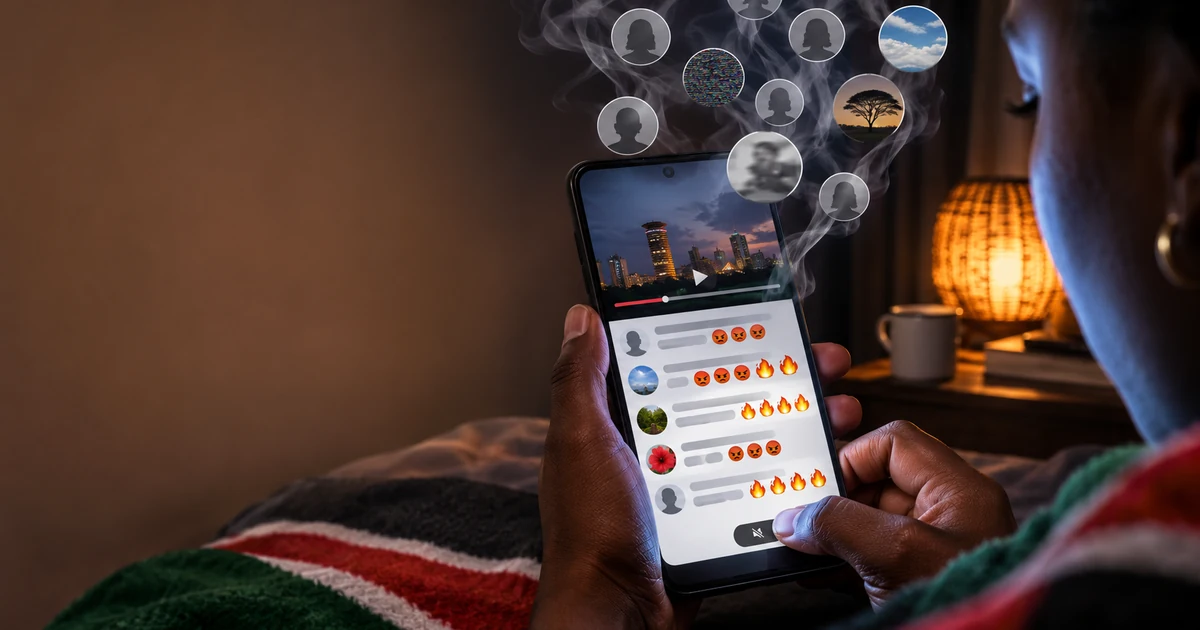
You open TikTok or Facebook to watch a candidate’s new video. Before the video ends, you’re already in the comments, and someone has written something so insulting, so tribal or so stupid that your thumbs start typing on their own. Ten minutes later you’ve written three replies, two strangers have insulted your mother, and the video has collected another 200 comments. That’s rage bait working exactly as designed. This guide explains the meaning of rage bait, who is behind the angry comments under Kenyan political posts, how to spot fake accounts and hired commenters, and how to starve them instead of feeding them as we head towards the 10 August 2027 General Election.
This playbook covers Fair Play, Yellow Card and Red Card tactics for educational purposes only. Nairobi Marketing does not provide services to political candidates, parties or campaigns, and has no affiliation with any candidate or party. See the full disclaimer below.
This article is part of our Political Campaign Digital Marketing in Kenya: 2027 Playbook. If you want the full picture of how campaigns use digital marketing, from the rules to election day, start there.
What Is the Meaning of Rage Bait?
Rage bait is content made to make you angry, because angry people engage. Oxford University Press named it the 2025 Word of the Year and defines it as online content “deliberately designed to elicit anger or outrage” by being frustrating, provocative or offensive, usually to drive traffic or engagement. Oxford’s data showed use of the term roughly tripled in a year, and more than 30,000 people voted on the pick (WFTV).
Clickbait makes you curious. Rage bait makes you furious. In Kenyan politics it shows up in three main places:
- The post itself: a caption or clip built to provoke, such as a half-truth about a rival, a mocking edit or a deliberately insulting question.
- The comments: planted remarks under a video, written to start a fight between supporters, between regions or between generations.
- The reply chain: once a fight starts, real people keep it going for free, and every reply pushes the post further.
The rage bait meme: when Kenyans call it out
Kenyans online have become quick at spotting the obvious stuff. Under a provocative post you’ll now see replies like “rage bait” or “usiingie box” (don’t take the bait), plus the rage bait meme: a reaction image or sticker that tells the poster “we see what you’re doing.” That instinct is healthy. The catch is that a meme reply is still a reply. To the algorithm, a comment calling something rage bait looks almost the same as a comment falling for it. More on how to starve it properly below.
Why Rage Bait Matters Most on a Candidate’s Promo Video
Here’s the part most voters miss. When you argue in the comments of a candidate’s video, even to criticise them, you’re often doing their marketing for free.
Recommendation systems on TikTok, Facebook, Instagram and YouTube read engagement as a sign that a post is worth showing to more people. Comments are a strong signal. Experienced creators report that videos with long comment threads keep getting pushed for days, and TikTok’s own explanations of the For You feed list comments among the interactions it learns from (MakeUseOf explains how comments shape recommendations). The algorithm counts comments. It can’t easily tell love from hate.
Research backs this up. A study of about 2.7 million Facebook and Twitter posts by politicians and news outlets found that each word referring to the opposing political side raised the odds of a post being shared by 67%. Posts attacking the “other side” were shared about twice as often as posts praising one’s own side (Rathje, Van Bavel and van der Linden, PNAS 2021). The data comes from the United States, but the mechanics are the same on a Kenyan phone.
So picture this. A candidate posts a two-minute promo reel. It’s average. Then three accounts drop provocative comments underneath. Hundreds of critics pile in to argue, supporters pile in to defend, and the reel reaches people who would never have seen it. The critics believe they’re fighting the campaign. In reach terms, they’re working for it.
Kenya is fertile ground for this. Kenyans spend more time on TikTok than any other country (Reuters Institute via OkayAfrica), and Facebook still has the widest reach, at 69.9% (The Star). TikTok is where we spend the hours. Facebook is where everyone, including your aunt and your MCA, is present.
Hired Comment Squads: Who Is Really Typing?
Not every angry comment is organic. Kenya has a well-documented paid influence industry, and much of it now operates in comment sections, not just on trending hashtags.
- The Mozilla Foundation’s 2021 research found at least 11 paid disinformation campaigns on Twitter (now X), involving more than 3,700 accounts and over 23,000 tweets, many aimed at journalists, judges and civil society (HapaKenya).
- A 2026 Konrad-Adenauer-Stiftung study found that influencers are recruited through coordinated networks, often given instructions in WhatsApp groups, and some reportedly earn about Sh1,300 to Sh1,950 per campaign (The Star).
- Amnesty International reported in November 2025 that paid networks were used to harass Gen Z protesters online and push messages onto X trends (Amnesty International).
- In September 2026, AI company Anthropic reported that it had found and removed a Kenya-based operator who was using its AI to mass-produce fake “grassroots” posts praising a Cabinet Secretary and attacking opposition figures ahead of 2027. Anthropic said the activity stayed inside a network of fake accounts and did not reach real people (Citizen Digital).
Hashtag armies and bot networks are covered in depth in our Red Card Files and our guide to influencers, communities and paid hashtag campaigns. This article focuses on what you see under a post. Hired comment squads typically do three jobs:
- Provoke. Drop tribal or regional jabs, insults about a rival’s family, or deliberately ignorant claims, then wait for real people to explode.
- Praise. Flood an unpopular candidate’s posts with “Huyu ndiye rais wetu!” and “Leader of the people 🔥🔥” so a newcomer thinks everyone loves them. This is social proof, faked.
- Punish. Swarm anyone who criticises their candidate with insults until the critic goes quiet and other people learn not to speak.
What I saw on a ward Facebook page
I’ve watched the third job happen up close. There’s a ward Facebook page I followed for local news. Every time a resident posted a complaint about the incumbent, a road not done or a bursary that never came, the same group of accounts would arrive within minutes and tear into them. Not with answers. With insults. Personal ones. After a while I stopped reading the complaints and started reading the attackers, and it was always the same names, the same tone, the same timing. The residents with real questions stopped posting. That was the point. A ward page that should have been a town hall became a place where people learned to keep quiet.
That is what this article is really about. Rage bait isn’t just noise. It decides who feels safe to speak.
Bots Meaning: Bots, Sockpuppets and Paid Humans
People call every suspicious account a “bot,” but there are actually three different things behind fake engagement. Knowing which one you’re looking at helps you spot them.
| Type | What it is | Typical giveaway |
|---|---|---|
| Bot | An account run partly or fully by software that posts, likes or shares automatically. | Posts at inhuman speed or at all hours, repeats identical text, rarely replies sensibly. |
| Sockpuppet | A fake identity run by a real person, often one person running many accounts. | Several “different” people with the same writing style, same mistakes, same posting times. |
| Paid human (real account) | A real person, often with a real following, paid to post or comment without saying so. | Sudden interest in one politician, identical talking points with others on the same day. |
Today the lines blur. AI tools let one sockpuppet operator write in many voices, and paid humans often run a few fake accounts alongside their real one. That’s why the checks below look at patterns, not single comments.
How to Spot Fake Accounts: Three Checks Any Kenyan Can Do
You don’t need special software. You need two minutes and some suspicion. Run these three checks before you reply to anyone who has made you angry.
1. The Kenyan language test
Real Kenyans online code-switch. We mix English, Swahili and Sheng in one sentence, drop in a “bana,” “aki,” “si ndio” or “wueh,” misspell things in familiar ways and use local references. A comment like “Hii barabara ilikuwa promise ya 2022 bana, mpaka leo ni vumbi tu” sounds like a real person from a real place.
Now compare a comment written in stiff, perfect English with no local flavour, or Swahili that reads like a textbook or a translation app, especially when it’s packed with insults or tribal provocation. That’s a red flag. Paid operators working at volume, or using AI, often write in a neat, generic register that no Kenyan uses when they’re genuinely annoyed.
One caution: plenty of real people write formally, and plenty of fake accounts can mimic Sheng. The language test is a warning light, not a verdict. Combine it with the next two checks.
2. The profile check
Tap the name. A fake or hired account often shows several of these:
- Only two or three photos, all uploaded around the same time.
- Photos that don’t match each other: a different-looking person in each, or a mix of a model, a car and a sunset.
- No real setting: no friends’ faces, no recognisable town, no family events, no matatu selfie, nothing that ties the person to a place.
- AI or downloaded images: overly smooth skin, odd ears or earrings, warped backgrounds, or a photo that turns up elsewhere in a reverse image search.
- A new account, created weeks or months ago, often around a political moment.
- Name changes: on Facebook, pages show their name history under Page Transparency. A “Nairobi Fashion Hub” that became a campaign fan page is a classic switch.
- Bought-looking friends or followers: thousands of followers, most with no photo, foreign names unrelated to Kenya, or empty profiles.
- Only posts about one candidate or one tribe. Real people post about football, church, their kids, fuel prices and Friday plans. Hired accounts have one topic.
3. The behaviour check
Now look at what the account does, not who it claims to be:
- The same accounts on every post. If the same five names appear first under every video from one candidate, or attack every critic, that’s a squad.
- Comments minutes apart. A burst of similar comments within a few minutes of posting suggests coordination, often from a WhatsApp group brief.
- Identical phrases. Different accounts using the same unusual phrase, the same emoji pattern or the same misspelling.
- Odd hours. Heavy activity at 3am, every night, in bursts.
- Nothing personal. They never reply to questions about themselves, never tell a story and never change the subject. They exist to attack or applaud.
If an account fails two of the three checks, treat it as suspect and don’t reply. If it fails all three, report it.
Fake accounts on Facebook: how big is the problem?
Big, and constant. Meta reports that it took action against 692 million fake Facebook accounts in the third quarter of 2025 and 1.1 billion in the fourth quarter, globally (Meta’s report under the EU Code of Practice on Disinformation). Many are caught at sign-up, but enough survive to fill comment sections. When a platform purge happens, you’ll sometimes see a politician’s follower count drop overnight. That’s a clue worth noticing.
How many fake followers on Instagram? And how to get rid of them
No platform publishes an exact fake-follower count for any account, and third-party “fake follower checkers” give estimates at best. The practical test is engagement: a page with 200,000 followers that gets 40 likes and five generic comments per post probably has a lot of empty followers.
If you run a business or personal account and want to clean up fake followers on Instagram:
- Open your Followers list, search for obvious fakes (no photo, no posts, random strings of letters) and tap Remove.
- Use Hidden Words in Settings to filter spam and offensive comments automatically.
- Use Restrict on accounts that harass you: their comments become visible only to them unless you approve them.
- Never buy followers. Fake followers drag down your engagement rate, and the algorithm reads low engagement as low interest.
Why Insults Backfire
Campaigns that rely on insult squads are often hurting themselves. Robert Cialdini’s research on influence lists liking as a core principle: we say yes to people we like. Nobody likes the person, or the movement, that insulted them in public. Dale Carnegie made the same point in plainer words: you can’t win an argument, because even when you “win,” the other person resents you. We explore both books in our guide to persuasion techniques.
Think about the swing voter reading the comments. They see a resident asking a fair question and a pack of accounts tearing into them. They don’t think “wow, this candidate is popular.” They think “these people are bullies,” and they quietly move their vote. Insult squads can win the comment section and lose the ward.
Rage Bait as a Reach Tactic: The Cards
Here’s how rage-bait tactics rate on our card system. For how each card works, see the pillar playbook.
🟢 Fair Play: Honest debate hooks from the official account
A candidate’s own account asks a real question that invites real opinions: “Which road in our ward should be fixed first? Tell us your stage.” Or it takes a clear, honest position on an issue and invites disagreement. The comments are lively because the question is real, and the candidate gets useful feedback.
Why it’s Fair Play: transparent, from a named account, no fake voices, and it treats voters as people with opinions rather than fuel.
🟨 Yellow Card: Engagement-bait captions
Captions built to farm reactions rather than discussion: “Comment YES if you support our governor,” “Type 2027 if you’re ready,” or “Tag someone who still supports the other side 😂.” Meta has demoted this kind of post since 2017, describing comment-bait, tag-bait and vote-bait as attempts to game its ranking, with stricter demotions for Pages that do it repeatedly (Meta).
Can they get away with it? Often. It’s not illegal, and many posts slip through, but a Page that does it a lot sees its reach fall.
What happens if caught: post-level and Page-level demotion on Facebook; a cheap-looking brand that serious voters scroll past.
🟨 Yellow Card: Supporters told to “go and start fights”
Real supporters, using their own real accounts, are briefed in a WhatsApp group to go into a rival’s comments and pick fights, or to pile onto critics. No fake accounts are involved, but the “spontaneous” anger is organised. If those supporters are paid and don’t say so, the Media Council of Kenya’s 2027 election guidelines on disclosing paid election messages come into play (Business Today).
Can they get away with it? Sometimes. It’s hard to prove coordination when real people post under their own names, but leaked WhatsApp screenshots and identical wording expose it regularly.
What happens if caught: public embarrassment when the group chat leaks; account restrictions for harassment; and if the fights turn into hate speech or threats, the same legal exposure as the Red Card below.
🟥 Red Card: Planted provocation from fake accounts
What it is: networks of fake or sockpuppet accounts that post provocative comments under a candidate’s own videos, or under a rival’s, to trigger arguments and fake a groundswell. The same networks praise their candidate and swarm critics.
Why campaigns use it: it buys reach cheaply, makes an unpopular candidate look loved, and scares critics into silence.
Real cases: Mozilla’s 2021 research on paid campaigns targeting journalists and judges; Amnesty’s 2025 findings on paid harassment networks; Anthropic’s 2026 removal of a Kenyan operator generating fake grassroots posts (all linked above).
How it gets caught: identical wording across accounts, simultaneous posting, the same accounts every time, leaked briefs, platform takedowns for coordinated inauthentic behaviour, and researchers and journalists mapping the networks.
Can they get away with it? Sometimes. Small local networks often survive a whole campaign. Larger ones increasingly get mapped, purged and reported in the news.
What happens if caught: mass account removals that wipe out the “support” overnight; a news story that becomes the campaign’s headline; and where content is false or harmful, possible exposure under the Computer Misuse and Cybercrimes Act. See our guide to election laws in Kenya.
🟥 Red Card: Tribal bait
What it is: comments or posts designed to set communities against each other, so that a political video turns into an ethnic fight. It’s the most dangerous kind of rage bait in Kenya, and we won’t give examples, because repeating them spreads them.
Why campaigns use it: ethnic anger is the fastest fuel there is. It mobilises a base and drowns out issue debate.
How it gets caught: NCIC monitoring, user reports, journalists and the same network signals as above. Kenyans also remember: screenshots last longer than campaigns.
Can they get away with it? Rarely, at scale. Anonymous accounts sometimes escape, but the NCIC has made clear that digital posts carry the same legal consequences as public speeches (AllAfrica), and named politicians and influencers are increasingly summoned.
What happens if caught: NCIC summons and possible prosecution under the National Cohesion and Integration Act, platform bans, and lasting reputational damage. And beyond the law, we know from 2007/08 where ethnic incitement can lead. Read After the Vote: Peace, Patriotism and the Legal Path.
Backfire risk for every campaign: rage bait draws attention, but it attracts the wrong kind. It reaches people who already dislike you, gives your rivals screenshots and teaches swing voters that your movement is angry. Reach without trust doesn’t turn into votes. For how campaigns should respond when they’re the target, see our crisis management guide. On memes and mockery specifically, see Memes, Ridicule and the Defamation Line.
Starve It, Don’t Feed It: Platform by Platform
The single best thing you can do with rage bait is give it nothing: no comment, no share, no stitch, no “see how stupid this is.” Every platform gives you tools to tell the algorithm “less of this, please.” Here’s how to use them.
TikTok (start here: it’s where Kenyans spend the most time)
- Not interested: long-press the video and tap “Not interested.” TikTok says it will show fewer similar videos (TikTok Newsroom).
- Swipe away fast. Watch time is a strong signal. Lingering on a video, even angrily, tells TikTok you want more.
- Report hateful, threatening or false content: long-press, then Report.
- No duets or stitches of rage bait, even to “expose” it. A stitch puts the original in front of your followers.
- Keyword filters: in Settings, Content preferences, you can filter up to 200 keywords and hashtags, and TikTok’s smart filter catches similar words and slang (Citizen Digital). Add a rival’s nickname, a tribal slur you keep seeing or a toxic hashtag.
- Creators: turn on comment filters and filter keywords on your own videos.
Facebook (the widest reach in Kenya)
- Hide post: tap the three dots on the post, then “Hide post,” to see fewer like it.
- Snooze: mute a person, Page or group for 30 days. It’s perfect for that relative who shares every political fight.
- Hide all from: remove a Page or person from your feed without unfriending.
- Reels: use the menu and choose “Show less” on rage-bait reels.
- Group and Page admins: turn on keyword blocking and profanity filters, use admin moderation tools, and set rules against coordinated attacks.
- Hide rather than delete abusive comments on your own posts. A hidden comment stays visible to the person who wrote it and their friends, so the troll doesn’t know, and you don’t hand them a “they deleted my comment” story.
- Don’t forward rage bait, even with “is this true?” Ask the sender for a source instead.
- Watch for the “Forwarded many times” label: it means the message didn’t start with the person who sent it to you.
- Block and report numbers that push hateful or false political content, and exit groups that exist only to spread it.
YouTube
- Use “Not interested” and “Don’t recommend channel” from the three-dot menu.
- Don’t argue in the comments of a political video. Comment counts help it rank.
- Creators: use blocked words and “hold potentially inappropriate comments for review.”
- Tap “Not interested” on suggested posts and reels.
- Turn on Hidden Words to filter offensive comments and message requests.
- Use Restrict and Limits during a pile-on.
X (Twitter)
- Mute words, hashtags and accounts rather than quote-tweeting them. A quote-tweet amplifies.
- Use “Not interested in this post” on the For You tab.
- Check Community Notes before reacting, and block accounts that only exist to provoke.
Screenshot, don’t share
If you need to warn people, alert a journalist or report hate speech to the NCIC, take a screenshot rather than sharing the post. A screenshot preserves the evidence without sending traffic to the original. Crop out ordinary people’s names, and never add the rage bait’s own caption to your share.
The Voter Rule
Angry comments are fuel. Starve it: Not interested, hide, report, move on.
FAQs: Rage Bait and Fake Accounts in Kenya
What is the meaning of rage bait?
Rage bait is online content created to make you angry so that you comment, share or react. Oxford named it the 2025 Word of the Year. In politics, it includes provocative posts and planted comments meant to start arguments that boost a post’s reach.
What does “bots” mean on social media?
A bot is an account run partly or fully by software that posts or engages automatically. People often use “bots” for any fake account, but many fake accounts are actually sockpuppets (fake identities run by real people) or real people paid to post without disclosure.
Does commenting on a politician’s video help it, even if I’m criticising?
Usually, yes. Recommendation systems treat comments as engagement and show busy posts to more people. If you strongly disagree with a video, the most effective response is often to scroll past, mark it “Not interested” or report it if it breaks the rules.
How do I know if a Facebook account is fake?
Run three checks. The language test: does it sound like a real Kenyan? The profile check: only a few photos, no real setting, a new account, name changes, one-topic posting. The behaviour check: the same accounts on every post, comments minutes apart, identical phrases, odd hours. Two or more red flags means don’t engage.
Is it illegal to run fake accounts for a politician in Kenya?
Running a fake account breaks every major platform’s rules. Whether it breaks the law depends on what the account does. Spreading false information, impersonation, harassment and hate speech can attract action under the Computer Misuse and Cybercrimes Act and the National Cohesion and Integration Act. See our guide to Kenya’s election laws and consult an advocate for specifics.
How do I get rid of fake followers on Instagram?
Go to your Followers list and remove obvious fakes (no photo, no posts, random usernames). Turn on Hidden Words, restrict harassers, and never buy followers. Fake followers lower your engagement rate, which can hurt your reach.
Where do I report tribal hate speech online?
Report it on the platform first, using the hate speech option. You can also report it to the National Cohesion and Integration Commission (NCIC). Keep screenshots with the date, time and account name, and don’t reshare the original post.
What is a rage bait meme?
It’s a reaction image, sticker or phrase people use to call out obvious rage bait, essentially saying “I see what you’re doing.” It’s a good instinct, but replying with a meme still counts as engagement. Ignoring the post starves it better.
Related Articles in the 2027 Playbook
- Political Campaign Digital Marketing in Kenya: 2027 Playbook (the pillar)
- Disinformation in Kenyan Politics: The Red Card Files
- Influencer Marketing in Kenyan Politics: Podcasts, Communities and More
- Memes, Ridicule and the Defamation Line
- Crisis Management for Campaigns: Deepfake Response Guide
- After the Vote: Peace, Patriotism and the Legal Path
For the full map of tactics, from the rules to the results, go back to the complete 2027 Playbook.
Want more plain-English guides to how the internet really works in Kenya? Subscribe to the Nairobi Marketing blog. And if you run a business that wants real, honest reach on Google, TikTok and Facebook, with no bots and no bought followers, talk to our team about SEO, Google Ads and content for your brand.
Disclaimer: This article is for educational and informational purposes only. Nairobi Marketing does not offer services to political candidates, parties or campaigns, and has no affiliation with any candidate or political party. The article describes tactics used in political campaigns, including deceptive and illegal ones, so that voters, journalists and the public can recognise and respond to them. It is not legal advice and does not endorse breaking any law or platform policy. Laws referenced, including the Elections Act, Election Offences Act, Election Campaign Financing Act, Computer Misuse and Cybercrimes Act, Data Protection Act, National Cohesion and Integration Act and Gambling Control Act, may change. Consult a qualified advocate before running any campaign activity.