Influencer Marketing in Kenyan Politics: Podcasts, Parasite SEO, Communities and Paid Voices
How influencer marketing, podcasts, parasite SEO, Facebook groups, Reddit and WhatsApp shape Kenya's 2027 election campaigns, with Fair Play, Yellow Card and Red Card verdicts so voters can spot the dirty tricks.

In Kenya’s 2027 race, the most persuasive message will rarely come from a candidate’s own page. It will come from a podcast host your cousin trusts, a Facebook group where your ward argues about water, a WhatsApp forward from your chama, or a TikTok creator who suddenly cares a lot about one aspirant. This guide explains how influencer marketing, podcasts, parasite SEO and online communities are used in Kenyan political campaigns, which tactics are fair, which bend the rules, and which cross the line, so voters, journalists and the public can tell the difference.
This playbook covers Fair Play, Yellow Card and Red Card tactics for educational purposes only. Nairobi Marketing does not provide services to political candidates, parties or campaigns, and has no affiliation with any candidate or party. See the full disclaimer below.
This article is part of our Kenya 2027 Political Campaign Digital Marketing Playbook. If you are new to the series, start there for the card system and the bigger picture.
How the cards work: 🟢 Fair Play (Siasa Safi) is legal, platform-compliant and honest. 🟨 Yellow Card (Siasa za Ujanja) bends platform rules or exploits loopholes. 🟥 Red Card (Siasa Chafu) deceives voters or breaks the law. Every Yellow and Red tactic carries a verdict on whether campaigns get away with it, and what happens when they don’t.
Why borrowed voices matter so much in Kenya
Kenyans spend about 5 hours 10 minutes a day on social media, more than any other country. Most of that time is not spent on politicians’ pages. It is spent with creators, comedians, podcasters, group admins and friends. A candidate who only talks from their own account is talking to people who already follow them. Borrowed voices reach everyone else.
That is the whole logic of influencer marketing in politics: trust moves through people. The same logic is why it is so easy to abuse. When you can’t see who paid for a voice, you can’t judge it properly.
Podcasts: the long conversation voters actually finish
Why podcasts matter in Kenya
Kenyan politicians have discovered the couch. Citizen Digital calls them “podtricians”. Nairobi Senator Edwin Sifuna’s 2024 appearance on Mic Cheque passed 360,000 views and became one of the show’s most popular videos. He moved between Swahili, English and Sheng and talked about his upbringing, money and politics. Martha Karua sat for a roughly seven-and-a-half-hour episode of Cleaning the Airwaves. Jimi Wanjigi, Okiya Omtatah, Eugene Wamalwa, Hassan Joho and Kipchumba Murkomen have all done the rounds on shows like Iko Nini, Hey Mama! and Obinna TV.
Incumbents now run their own. Nairobi Governor Johnson Sakaja launched a City Hall podcast, let’s talk, on 3 September 2026 and described it as a “digital baraza” for residents. The Standard reports it will also carry his administration’s scorecard and vision as he seeks re-election.
Why the rush? A podcast gives a candidate an hour or more with a relaxed host and an audience that chose to listen. USIU-Africa’s Dr Ruth Owino told Citizen Digital that podcasts let politicians control their story without the tough questioning of a mainstream interview, and warned that the lack of fact-checking can let misleading claims travel unchecked. Both points are true at once, and both matter to voters.
Choosing shows by voter segment
Smart campaigns pick podcasts the way they pick radio stations: by who listens, not by who is famous.
- Gen Z and young millennials: youthful couch shows that mix Sheng, humour and money talk.
- Women voters: shows hosted by women that cover family, work and safety.
- Professionals and the middle class: long-form interview shows that dig into policy and personal story.
- Faith audiences: church and ministry podcasts, where the rules on politicking are strict (see our guide to Kenya’s election laws).
- Vernacular audiences: local-language shows and community radio podcasts, which often reach people national shows never touch.
Clip-able lines and the clip machine
Very few voters will sit through a three-hour episode. Most will see 30 seconds of it on TikTok, Reels or a WhatsApp status. That is why campaigns prepare clip-able lines: short, vivid answers that make sense without context. “I grew up carrying water from the river, so don’t tell me about water projects” will travel. A five-minute answer about budget lines will not.
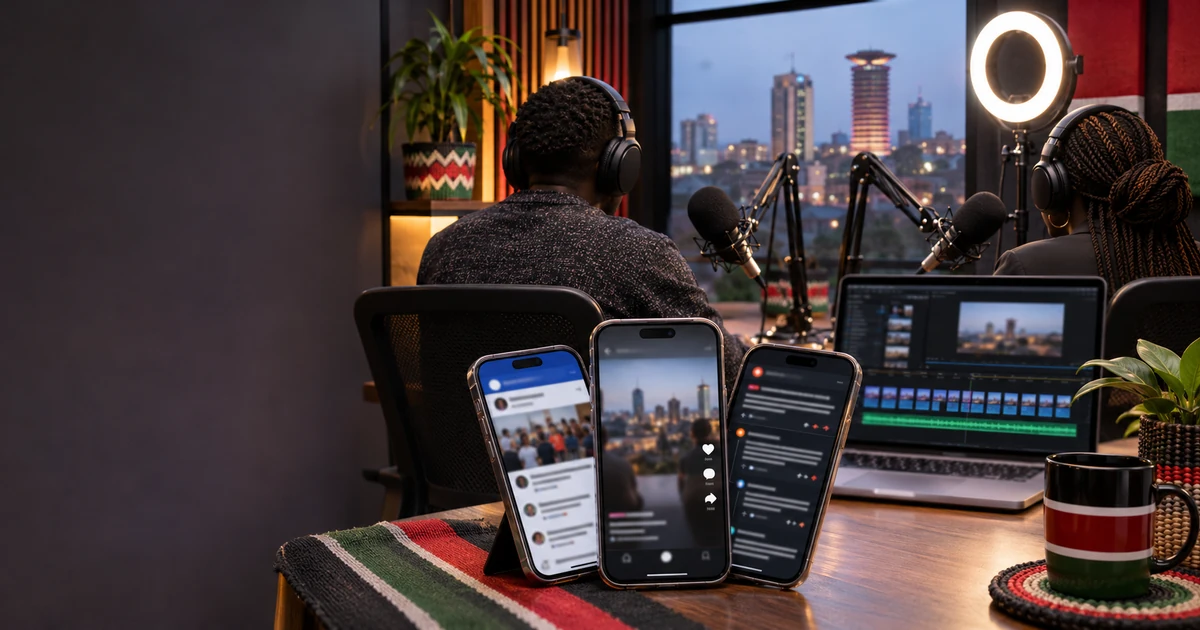
One well-planned episode can become 20 to 30 clips: the personal story, the funny moment, the policy promise, the response to a critic, the Sheng line, the emotional moment. Each clip gets captions, a vertical crop and a hook in the first two seconds. This is 🟢 Fair Play, as long as the clips are not edited to change the meaning of what was said. When the clip gets cut to make a rival look bad, that is a different card entirely (see our guide on memes and the defamation line).
🟢 Fair Play: the candidate’s own podcast
Running your own show, as Sakaja has, is legal and honest when it is clearly branded as the candidate’s or office’s channel. The risk is boredom: a podcast that is just a press release with a microphone won’t keep anyone. The ones that work bring in residents, critics and real questions.
🟨 Yellow Card: paid podcast appearances without disclosure
Some appearances are not invitations. A fee, a “facilitation” or a quiet sponsorship changes the conversation: softer questions, no follow-ups, a host who suddenly agrees. The audience thinks they are watching an interview. They are watching an advert.
The Media Council of Kenya’s 2027 election coverage guidelines call for disclosure when influencers and digital creators share election messages for payment, and require paid political content to be clearly distinguishable from independent content, as Business Today reports. YouTube also requires creators to tick its paid promotion box when content is sponsored.
Can they get away with it? Sometimes. Payments are private and rarely leak, but hosts who take money from everyone get noticed, and rival camps love exposing deals.
What happens if caught: The host’s credibility takes the biggest hit, the episode becomes a meme, complaints can go to the Media Council, and the platform may remove or restrict the content.
Voter tip: Watch for what isn’t asked. If a host who grills everyone else goes soft on one aspirant, ask why.
Parasite SEO: borrowing Google rank from big platforms
When a voter googles “who is the MCA for Kilimani” or “Ruaraka MP aspirants 2027”, a brand-new campaign website won’t rank. But YouTube, Facebook, Instagram and X already have huge authority in Google. Parasite SEO means publishing on those platforms so the platforms do the ranking for you.
SEO practitioner Jesper Nissen laid out his method on the In the Pit with Cody Schneider podcast. Treat page one as territory: publish on several high-authority platforms (a YouTube video and Community post, an X Article, an Instagram post, a Facebook Page post) and link them to each other. Put the target keyword in the very first words of Facebook and Instagram captions, because those words often become the title Google shows. Nissen reports that Instagram and Facebook posts began showing up in Google results around mid-2025. Treat this as what experienced practitioners report, not as an official Google statement.
🟢 Fair Play: owning your own name and office
Applied to politics, the honest version looks like this:
- Pick the searches voters actually type: the candidate’s name, “[ward] MCA”, “[constituency] MP aspirants”, “[county] governor manifesto”.
- Start captions with that phrase. “Kilimani Ward MCA aspirant [Name]: here’s my plan for the Argwings Kodhek drainage” beats “Good morning family!”
- Publish the same story as a YouTube video, an X Article, an Instagram post and a Facebook Page post, all on the candidate’s own verified accounts, all linking to each other and to the campaign website.
- Say the name, office and location out loud in videos too. That feeds captions, transcripts and AI search, which we cover in our guide to AI search and the 2027 election.
Everything here is open, attributed and honest. It simply makes sure a voter who searches finds the candidate’s own words first.
🟨 Yellow Card: unbranded “information” sites and pages
The bent version uses neutral-sounding domains and pages, like “[Ward] Updates” or “[County] Development Watch”, that are quietly run by a campaign. They rank for local searches and look independent, but they only ever praise one person.
Can they get away with it? Often. Domain ownership is easy to hide and few voters check.
What happens if caught: The “independent” label collapses and every post on it becomes evidence of deception. If the site starts publishing false stories, it has become a Red Card (see the fake news sites section below).
Facebook groups: where the ward actually talks
Facebook still has the widest reach of any platform in Kenya, at 69.9% of users. In many wards the real public square is a Facebook group: “[Estate] Residents”, “[Ward] Development Forum”, “[Town] Buy and Sell”. Water cuts, insecurity, road works and funerals all get discussed there first.
🟢 Fair Play: keyword-first posts in groups
Posts that lead with the problem and the place get read and searched: “Kayole North water cuts: here’s what the ward office is doing” will be found weeks later by a resident searching the group. Posts that lead with a slogan get scrolled past.
🟢 Fair Play: the MCA assistant team posting as themselves
At ward level, a team of three to five assistants who post under their own real names, saying openly that they work with the MCA or the aspirant, is honest and effective. “Hi neighbours, I’m Kevin from the MCA’s office. The borehole repair starts Monday” builds trust because people know exactly who Kevin is. We cover team sizes and budgets in our office-by-office playbook.
🟨 Yellow Card: undisclosed assistants
The same team, pretending to be ordinary residents, is a different story. “Wow, our MCA is working so hard!” from someone on the payroll is advertising dressed up as neighbourliness.
Can they get away with it? Often. Group admins rarely check, and in a big group a few voices get lost.
What happens if caught: Locals notice the same five accounts praising one person every day. When one is exposed, screenshots spread fast, members leave, and the candidate looks like they are hiding something. Admins may remove the accounts. For the darker version, hired squads that insult critics, see our guide to rage bait and fake accounts.
Reddit: small in Kenya, big in Google and AI answers
Reddit is not where most Kenyan voters hang out, but Kenyan subreddits such as r/Kenya punch above their weight. Threads rank in Google, and AI search tools quote Reddit discussions heavily. A thread asking “is [aspirant] legit?” can shape what a chatbot tells a curious voter months later.
🟢 Fair Play: real volunteers, AMAs and an official account
The honest playbook: real supporters taking part in their own voice, in the English, Swahili and Sheng mix Kenyan Redditors actually use; an “Ask Me Anything” session where the candidate answers hard questions in public; and an official, clearly labelled account. Reddit users are blunt and will ask the questions a friendly podcast won’t. A candidate who handles that well earns real credibility.
🟨 Yellow Card: paid locals without disclosure
Paying real Kenyans to post supportive comments under their own accounts without saying so breaks Reddit’s spirit and its rules on authentic participation. Reddit’s content policy asks users to post authentic content in communities where they have a personal interest.
Can they get away with it? Sometimes. Redditors dig through posting histories, and an account that only ever talks about one politician stands out.
What happens if caught: Moderators ban the accounts, the community posts a callout thread, and that callout often ranks for the candidate’s name.
🟥 Red Card: account networks and coordinated upvoting
What it is: Many accounts controlled by one operation, posting and upvoting each other to fake consensus. Why campaigns use it: Upvotes decide what rises, so faking them fakes popularity. How it gets caught: Reddit’s policy prohibits vote manipulation, and the platform runs detection for it. Accounts that vote together, were created together or only engage with one topic get flagged.
Can they get away with it? Rarely. Detection is mature and the community is suspicious by default.
What happens if caught: Site-wide bans, removed threads, and a public story about the candidate faking support.
WhatsApp: the most trusted channel in the country
A WhatsApp message from your sister, your chama or your church group carries more weight than any advert. That is exactly why it is so powerful, and so dangerous.
🟢 Fair Play: channels and opt-in groups
WhatsApp Channels let a candidate broadcast to people who chose to follow, without exposing anyone’s number. Opt-in groups, where people joined because they asked to, work for volunteers and ward updates. Under the Data Protection Act, adding people to groups or lists without their consent is a problem, and political canvassers must register with the ODPC, which has published guidance for electoral purposes. Consent done right is covered in the pillar playbook.
🟥 Red Card: false forward chains
What it is: Fabricated “breaking news”, fake quotes, invented threats or doctored documents written to be forwarded from group to group. Why campaigns use it: Forwards arrive from people you trust, there is no public record, and by the time a correction lands the damage is done. Real pattern: Africa Check and other fact-checkers regularly debunk fake front pages styled as the Standard or Daily Nation, many of which spread as images on WhatsApp. How it gets caught: Fact-checkers trace images back to their first posting, newsrooms deny stories publicly, and WhatsApp marks messages that have passed through many chats as “Forwarded many times”.
Can they get away with it? Often. Encryption makes the original sender hard to trace.
What happens if caught: False publication offences under the Computer Misuse and Cybercrimes Act, possible defamation suits, and NCIC action if the content is hateful. The NCIC has warned that digital posts carry the same legal consequences as public speeches.
Voter tip: “Forwarded many times” plus no named source plus urgent tone equals stop. Check before you share.
Earned and sponsored media: the newspaper’s borrowed trust
🟢 Fair Play: op-eds and labelled sponsored posts
A candidate writing an opinion piece under their own name, or a clearly labelled “Sponsored” or “Advertorial” feature on a news site, is honest. Readers know what they are reading. These pieces also earn links and mentions that help in Google and AI search.
🟨 Yellow Card: unlabelled sponsored posts
Paid content that looks like a normal news story, with no label, borrows the outlet’s credibility without telling readers it was bought. The MCK’s 2027 guidelines say paid political communication must be identified as sponsored or paid and kept clearly separate from editorial content.
Can they get away with it? Often, especially on smaller blogs and online “news” sites that depend on the money.
What happens if caught: Media Council complaints against the outlet, reputational damage to both sides, and a ready-made story for rival camps.
🟥 Red Card: fake news sites and sites copying real outlets
What it is: Websites built to look like real newsrooms, or invented “international” outlets, publishing false stories. Real cases: During the 2017 campaign, African Arguments documented look-alike sites such as standard-news.co.ke and K24-tv.com that copied mainstream content and slipped in fake stories. Quartz reported invented “foreign” outlets with fake bylines publishing stories against one candidate. More recently, Africa Check traced a run of fake Standard front pages to a Facebook page that kept imitating the paper’s design. How it gets caught: Newsrooms publicly disown the content, fact-checkers check domain registration dates, and readers spot odd URLs.
Can they get away with it? Sometimes. The sites get exposed, but often only after the lie has spread.
What happens if caught: Domain takedowns, defamation suits, false publication charges, and lasting damage to whoever is linked to the operation. For more dirty tactics, see the Red Card Files.
Warming up accounts early
Social platforms reward accounts with history. A page with two years of steady posting and real engagement gets distributed further than one created last week. That is why serious campaigns start early, and why some start dishonestly.
🟢 Fair Play: the candidate’s own accounts, started early
An aspirant who starts posting in 2026 as themselves, about their community, their work and their ideas, builds an audience that will still be there in July 2027. Those warmed-up accounts also carry content through the final days before the vote, which we explain in our election day guide.
🟨 Yellow Card: “neutral” pages that switch sides
What it is: A page that grows on football memes, Nairobi traffic updates, motivational quotes or “Mtaa News” for a year, then quietly starts pushing one candidate. Its followers never signed up for politics.
How to spot it: On Facebook, open the page and look for Page Transparency. It shows the date the page was created, any previous names, and the countries where the people managing it are based. A page called “[Aspirant] for Governor” that was “Funny Kenyan Videos” eight months ago tells you a lot.
Can they get away with it? Often. Most followers never check Page Transparency.
What happens if caught: Followers leave, screenshots of the name history circulate, and Meta may restrict pages that mislead people about their purpose.
🟥 Red Card: networks of switching pages
What it is: Dozens of these pages, run together, all switching at once and posting the same messages to look like a groundswell. Why campaigns use it: It manufactures the impression that “everyone” is supporting someone. How it gets caught: Identical posts within minutes, shared admins, matching creation dates and name changes, and platform investigations into coordinated inauthentic behaviour.
Can they get away with it? Sometimes. Small networks slip through; large ones attract platform takedowns and researchers.
What happens if caught: Mass removal of pages, public takedown reports naming the operation, and serious embarrassment for whoever is linked to it.
Influencer marketing and narrative-driving
How recommendation systems spread a topic
TikTok, Instagram, YouTube and X all use some form of collaborative filtering. In simple terms: if you watch videos about a topic, you get shown more of it, and people whose viewing looks like yours get shown it too. One creator talking about an aspirant is a video. Thirty creators talking about the same aspirant in the same week is a signal. The system starts treating the topic as something “people like you” care about and pushes it into feeds of people who never searched for it.
This is why influencer marketing in politics is less about one big name and more about saturation. Experienced creators report that clusters of similar videos posted around the same time lift each other, which matches how these systems are designed to work.
X trends work on a related principle. X says its trends algorithm picks topics that are “popular now” rather than ones that have been popular for a while. A sudden burst matters more than steady volume, which is exactly why coordinated bursts are attractive to manipulators.
🟢 Fair Play: genuine endorsements and disclosed partnerships
A creator who supports a candidate because they believe in them, and says so in their own words, is doing what citizens do. Where a creator is paid, honest practice is clear disclosure, as the MCK’s 2027 guidelines require. But check the platform rules first: TikTok bans paid political content from creators entirely, and Meta’s eligibility rules list current candidates and political parties as ineligible for its branded content and partnership ad tools. So a disclosed paid post may be honest with voters and still break a platform’s rules. On those platforms the Fair Play route is unpaid, genuine endorsement, or the candidate appearing on a creator’s content as a guest.
🟨 Yellow Card: undisclosed paid influencers
This is the most common tactic in Kenyan digital politics, and the hardest to see. Because TikTok bans political ads, money flows instead to undisclosed creator deals. A creator who never talked politics suddenly has strong views on one ward rep.
Can they get away with it? Often. Deals are cash or M-Pesa, there is no contract, and disclosure is rare.
What happens if caught: TikTok removes paid political content it finds, creators lose brand deals and trust, MCK complaints are possible, and leaked briefs become a story about the candidate. Since the election period opened on 20 August 2026, any creator handing out cash or gifts to followers on a candidate’s behalf also risks bribery offences.
🟥 Red Card: coordinated paid hashtag campaigns
What it is: Networks of paid accounts pushing the same hashtag at the same time to trend false or attack narratives about a person or institution.
Real case: Mozilla Foundation researchers Odanga Madung and Brian Obilo documented at least 11 such campaigns in Kenya in 2021, involving more than 3,700 accounts and over 23,000 tweets, as HapaKenya reported. Targets included journalists, judges and civil society. One participant said influencers earned roughly Ksh 1,000 to 1,500 for three campaigns a day, paid by M-Pesa, with content and instructions sent through WhatsApp groups. Eight of the 11 campaigns reached trends. A follow-up study found hashtags such as #phonyleaks trending to discredit the Pandora Papers.
Why campaigns use it: A trending hashtag looks like public opinion, gets picked up by blogs and sometimes by mainstream media, and drowns out the real conversation.
How it gets caught:
- Identical or near-identical wording across many accounts.
- Simultaneous posting, often within the same few minutes.
- The same accounts appearing in every campaign, whatever the topic.
- Leaked briefs and screenshots from the WhatsApp groups that coordinate them.
- Researchers and journalists mapping account networks.
Can they get away with it? Sometimes. Many campaigns trend for a day and vanish, but each one leaves a trail researchers can follow.
What happens if caught: Account suspensions, public research reports, possible defamation claims from targets, false publication offences and NCIC action where content is hateful. Mozilla reported that Twitter removed about 100 accounts after its research.
For how fake accounts behave in comment sections, see our rage bait guide. For bot networks and manufactured engagement, see the Red Card Files.
Quick reference: tactics and cards
| Tactic | Card | Get away with it? |
|---|---|---|
| Candidate’s own podcast or guest appearances | 🟢 Fair Play | No risk |
| Paid podcast appearance, not disclosed | 🟨 Yellow Card | Sometimes |
| Keyword-first posts on own verified accounts | 🟢 Fair Play | No risk |
| Unbranded “info” sites run by a campaign | 🟨 Yellow Card | Often |
| Assistants posting as themselves | 🟢 Fair Play | No risk |
| Assistants posing as ordinary residents | 🟨 Yellow Card | Often |
| Reddit AMAs and real volunteers | 🟢 Fair Play | No risk |
| Paid Redditors, not disclosed | 🟨 Yellow Card | Sometimes |
| Reddit account networks and vote rings | 🟥 Red Card | Rarely |
| WhatsApp channels and opt-in groups | 🟢 Fair Play | No risk |
| False WhatsApp forward chains | 🟥 Red Card | Often |
| Op-eds and labelled sponsored posts | 🟢 Fair Play | No risk |
| Unlabelled sponsored posts | 🟨 Yellow Card | Often |
| Fake news sites and copycat outlets | 🟥 Red Card | Sometimes |
| “Neutral” pages that switch sides | 🟨 Yellow Card | Often |
| Networks of switching pages | 🟥 Red Card | Sometimes |
| Undisclosed paid influencers | 🟨 Yellow Card | Often |
| Coordinated paid hashtag campaigns | 🟥 Red Card | Sometimes |
The voter’s quick check
- Sudden convert? A creator who never talked politics now posts daily about one aspirant. Ask who benefits.
- Same words everywhere? Ten accounts using the same phrase within an hour is a campaign, not a conversation.
- Page history? Check Facebook Page Transparency for creation date and old names.
- Soft interview? Notice the questions that weren’t asked.
- “Forwarded many times”? Find the original source before you forward.
- Odd news URL? Real outlets don’t publish from look-alike domains.
Frequently asked questions
What is influencer marketing in Kenyan politics?
It is the use of creators, podcasters, comedians, group admins and other trusted voices to carry a candidate’s message to audiences who don’t follow the candidate directly. Honest influencer marketing involves genuine endorsements or clearly disclosed paid content where the platform allows it. Dishonest versions hide payment or fake the scale of support.
Is it legal for influencers to be paid to promote Kenyan politicians?
Payment itself isn’t automatically illegal, but the Media Council of Kenya’s 2027 election coverage guidelines call for disclosure when creators share election messages for payment. Platform rules are stricter: TikTok bans paid political creator content entirely, and Meta restricts candidates and parties from its branded content tools. Since the election period opened on 20 August 2026, any cash or gifts passed to voters through influencers can also raise bribery issues. Speak to an advocate for specifics.
What are the best Kenyan podcasts politicians appear on?
Shows reported as hosting politicians include Mic Cheque, Cleaning the Airwaves, Iko Nini, Hey Mama! and Obinna TV. Which podcast is “best” for a candidate depends on the audience: youth couch shows, long-form interviews, faith shows and vernacular podcasts each reach different voters.
What is parasite SEO?
Parasite SEO means publishing on high-authority platforms such as YouTube, Facebook, Instagram and X so those platforms help your content rank in Google, instead of relying only on your own new website. Used honestly on a candidate’s own accounts, it helps voters find accurate information when they search.
How can I tell if a Facebook page has changed its name?
Open the page, find the Page Transparency section (usually in the About or info area), and look at page history. It shows the creation date, any previous names and the countries where the people managing the page are based.
How do paid hashtag campaigns get exposed?
Researchers and journalists look for identical wording, posts published within minutes of each other, the same accounts appearing across unrelated campaigns, and leaked instructions from coordination groups. Mozilla’s 2021 Kenya research is the best-known example.
Is a WhatsApp Channel better than a WhatsApp group for campaigns?
For broadcasting, yes. Channels let people opt in without exposing their numbers to everyone else, which is better for privacy and data protection. Groups work for active volunteers who chose to join. Adding people without consent creates data protection risk.
Why does a politician’s Reddit presence matter if few Kenyans use Reddit?
Reddit threads rank well in Google and are widely quoted by AI search tools. A single discussion about an aspirant can shape what a search engine or chatbot tells voters later.
Related reading
- The full Kenya 2027 Political Campaign Digital Marketing Playbook
- The Red Card Files: dirty political tactics and how to spot them
- Rage bait and hired commenters: how to spot fake accounts
- AI search and Kenya’s 2027 election
- Election day, the silence period and the Last Wave
- Election laws Kenya 2027: rules for digital campaigns
- Memes, ridicule and the defamation line
Back to the complete 2027 playbook.
Stay informed
Want more plain-language guides on how digital marketing really works in Kenya? Subscribe to the Nairobi Marketing blog. And if you run a business that needs SEO, Google Ads or content that ranks, talk to our team.
Disclaimer: This article is for educational and informational purposes only. Nairobi Marketing does not offer services to political candidates, parties or campaigns, and has no affiliation with any candidate or political party. The article describes tactics used in political campaigns, including deceptive and illegal ones, so that voters, journalists and the public can recognise and respond to them. It is not legal advice and does not endorse breaking any law or platform policy. Laws referenced, including the Elections Act, Election Offences Act, Election Campaign Financing Act, Computer Misuse and Cybercrimes Act, Data Protection Act, National Cohesion and Integration Act and Gambling Control Act, may change. Consult a qualified advocate before running any campaign activity.