
Rate structure
Set how a best available rate relates to corporate rates, wholesale and contract rates, packages and promotions. Compare rate plans with the same cancellation and meal terms.
Hotel revenue management in Tanzania covering room rates, demand forecasting, booking channels and reporting on ADR, RevPAR and occupancy. Separate northern circuit pickup from city events and weekday corporate room blocks.
Hotel revenue management is the process of deciding what to charge, how much inventory to sell, which channels to use and when to market the offer. It starts with collecting booking data and grouping demand by guest and stay type. Forecasting, optimisation and re-evaluation help decide when to adjust rates or availability. Yield management focuses on earning more from the rooms the property can sell for a particular date.
Set how a best available rate relates to corporate rates, wholesale and contract rates, packages and promotions. Compare rate plans with the same cancellation and meal terms.
Review demand forecasting and dynamic pricing by date and segment. Discuss the guest’s willingness to pay alongside what comparable properties are offering.
Check minimum stay, room limits and availability rules. A restriction should match demand and capacity. Do not rely on overbooking to hide a distribution problem.
Measure rate parity and net revenue after distribution costs. Pair this work with OTA management when listing or room mapping issues are involved.
Agree which KPIs to track and what decision each report is meant to support.
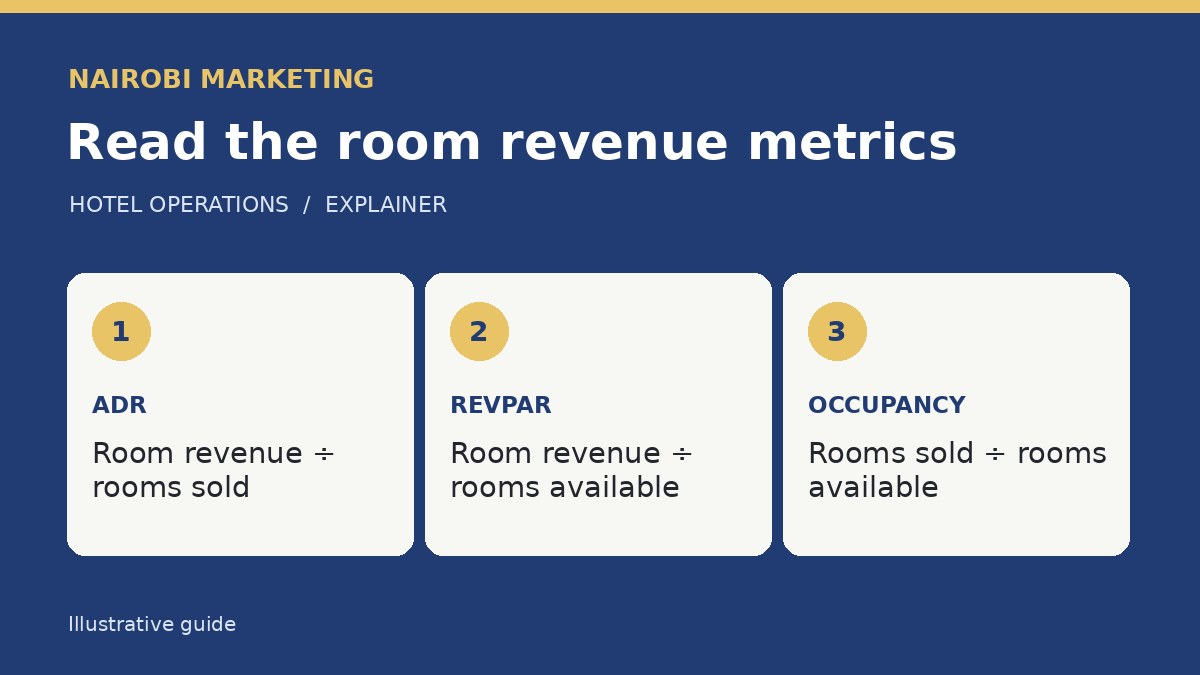
Read these measures together. A higher room rate can coincide with lower occupancy; RevPAR gives you a way to compare the effect on available rooms.
Room revenue divided by rooms sold.
Room revenue divided by rooms available.
The percentage of available rooms sold.
How far in advance a booking is made.
What has been added since a prior check, and how bookings are building against a comparable period.
The number of nights in a booking, tracked by segment where useful.
Total operating revenue per available room.
Gross operating profit per available room.
A hotel revenue management strategy joins supply and demand data with market segmentation. Compare weekday business against weekend leisure and watch changes in pickup after an event announcement. Review high and low season forecasts using your own availability and booking history. For reporting beyond rooms, confirm that point-of-sale and bookings data measure the same period. Coordinate promotions with your hotel marketing plan.
Before raising rates for a peak weekend or high season, look at the booking pace for the same room type and the cost of the package. Compare that with low season demand before changing your minimum stay or cancellation rules.
Separate northern circuit pickup from city events and weekday corporate room blocks.
Pick a competitive set with comparable room type, location, meal plan and flexibility. Rate shopping gives a view of public offers; it does not show a competitor’s occupancy, profit or market share. Record what is actually comparable before changing your own rate.
Discounting by default can make a hotel busier without improving net revenue. Opening every channel with the same rules can sell an offer on terms it cannot support. Compare room restrictions, package costs and the relevant bookings before reacting to a competitor’s headline rate.
A revenue management system (RMS) can support pricing decisions, a PMS holds property data, a channel manager distributes availability and rates, and the booking engine takes direct reservations. Tools to assess include IDeaS, Duetto and Lighthouse for revenue work; Oracle OPERA, Hotelogix, eZee Absolute, ResRequest and NightsBridge for property operations; and SiteMinder, STAAH and RateGain for distribution. We scope access and working arrangements with the property before committing to any specific connection.
Dar es Salaam, Arusha, Moshi and Zanzibar can involve very different customer journeys. A city service, a northern-circuit itinerary and a beach stay should not all receive the same message. We agree which offer and audience your Tanzania brief needs to address.
Nairobi Marketing is based in Nairobi. We agree remote collaboration, meetings and any on-site production needed for your Tanzania brief before work starts.
A property selling a city hotel, safari stop or coastal stay needs to understand the dates and segments behind its enquiries. We review the information available before recommending a pricing response.
See our hotel rate management services for the wider scope, or tell us which of these priorities applies to your business.
For the southern circuit, compare Nyerere National Park lodges and Ruaha stays only when inclusions match.
Request a scoped quotation. We price this engagement around your business, required work and delivery responsibilities. Share your website, priorities and target market so the quotation can explain the scope clearly.
Request a quotationCheck Tanzania National Parks (TANAPA) information before treating a park fee change as a lodging price change.
We establish room types, inclusions, occupancy conditions and approval responsibilities.
We examine the rate structure and reliable booking information supplied by the property.
Your team reviews the proposed structure, rules and any changes within the scope.
We use available booking information and operational feedback to support the next decisions.
Share your room categories, rate sheets, booking channels and the pricing questions you want to resolve. Tell us who approves changes and what performance data is available.
For properties in Tanzania, review demand by stay type before setting room rates or restrictions. For Arusha, compare pre-safari stays against weekend business. For Moshi and Mount Kilimanjaro, evaluate short stays before and after a Mount Kilimanjaro climb separately.
For Dar es Salaam, isolate late arrivals from Julius Nyerere International Airport when reviewing booking pickup. For Karatu, compare properties with similar meals and Ngorongoro Conservation Area access before setting rates.
For Serengeti, Tarangire and Lake Manyara, use separate benchmarks for Serengeti camps, Tarangire lodges and Lake Manyara stays if the inclusions differ. For Dodoma and Mwanza, compare negotiated business demand in Dodoma separately from Lake Victoria stays in Mwanza. Use the property’s own pace and net booking value to decide what changes. When two stays include different meals, transfers or activities, adjust the comparison before using a competitor’s rate as a benchmark. For a separate brief across the water, see our same service in Zanzibar.
Explore the same service in other markets:
We start with room categories, occupancy rules, meal plans, existing rate sheets and available booking performance. The exact scope depends on the quality of the information and systems available. Base a Lake Tanganyika package benchmark on comparable access and meal inclusions; do not automatically use a Rufiji River camp.
No. We support informed rate decisions within the agreed scope. Demand, distribution, guest experience and market conditions also affect the result.
The property sets the approval authority and decision limits. We document those responsibilities before any rate changes are proposed or implemented.
Start with existing booking and rate data. Add software only if the current reporting cannot support the decisions.
Compare booking pace, cancellation terms and remaining inventory against similar dates before raising prices or adding restrictions.
Review net room revenue, distribution costs and occupancy too.