
Rate structure
Set how a best available rate relates to corporate rates, wholesale and contract rates, packages and promotions. Compare rate plans with the same cancellation and meal terms.
Hotel revenue management in Zanzibar covering room rates, demand forecasting, booking channels and reporting on ADR, RevPAR and occupancy. Compare peak demand within the same island and room category. Separate Stone Town nights from longer Unguja resort stays.
Hotel revenue management is the process of deciding what to charge, how much inventory to sell, which channels to use and when to market the offer. It starts with collecting booking data and grouping demand by guest and stay type. Forecasting, optimisation and re-evaluation help decide when to adjust rates or availability. Yield management focuses on earning more from the rooms the property can sell for a particular date.
Set how a best available rate relates to corporate rates, wholesale and contract rates, packages and promotions. Compare rate plans with the same cancellation and meal terms.
Review demand forecasting and dynamic pricing by date and segment. Discuss the guest’s willingness to pay alongside what comparable properties are offering.
Check minimum stay, room limits and availability rules. A restriction should match demand and capacity. Do not rely on overbooking to hide a distribution problem.
Measure rate parity and net revenue after distribution costs. Pair this work with OTA management when listing or room mapping issues are involved.
Agree which KPIs to track and what decision each report is meant to support.
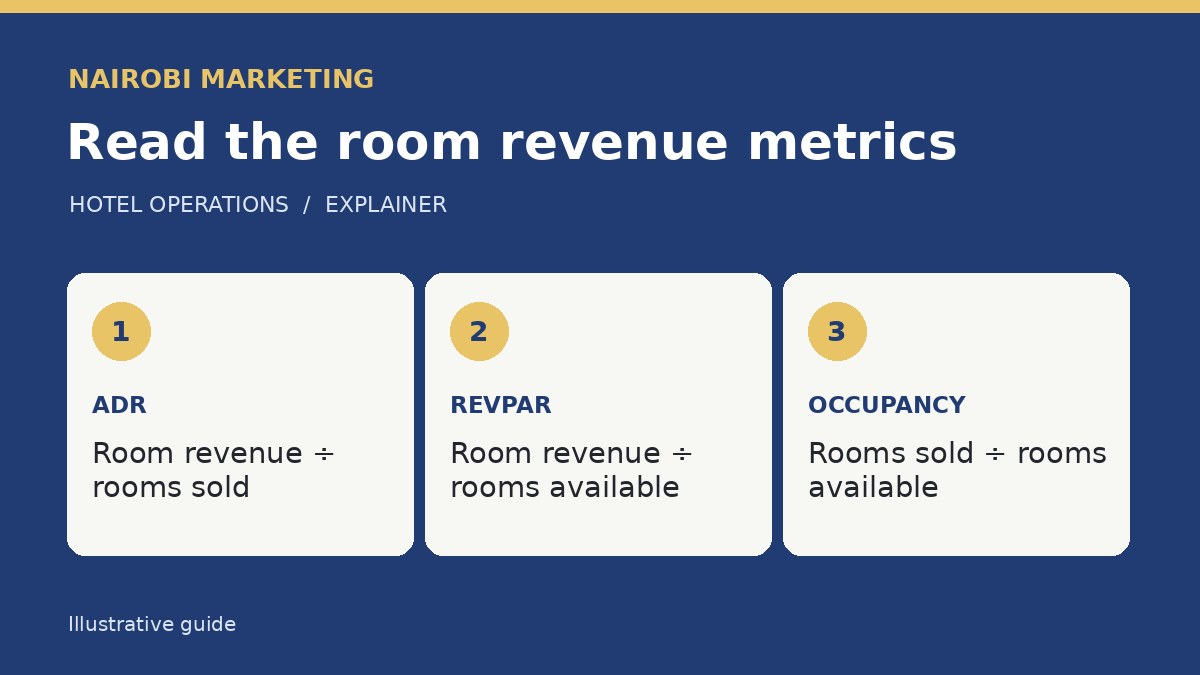
Read these measures together. A higher room rate can coincide with lower occupancy; RevPAR gives you a way to compare the effect on available rooms.
Room revenue divided by rooms sold.
Room revenue divided by rooms available.
The percentage of available rooms sold.
How far in advance a booking is made.
What has been added since a prior check, and how bookings are building against a comparable period.
The number of nights in a booking, tracked by segment where useful.
Total operating revenue per available room.
Gross operating profit per available room.
A hotel revenue management strategy joins supply and demand data with market segmentation. Compare weekday business against weekend leisure and watch changes in pickup after an event announcement. Review high and low season forecasts using your own availability and booking history. For reporting beyond rooms, confirm that point-of-sale and bookings data measure the same period. Coordinate promotions with your hotel marketing plan.
Before raising rates for a peak weekend or high season, look at the booking pace for the same room type and the cost of the package. Compare that with low season demand before changing your minimum stay or cancellation rules.
Compare peak demand within the same island and room category. Separate Stone Town nights from longer Unguja resort stays.
Pick a competitive set with comparable room type, location, meal plan and flexibility. Rate shopping gives a view of public offers; it does not show a competitor’s occupancy, profit or market share. Record what is actually comparable before changing your own rate.
Discounting by default can make a hotel busier without improving net revenue. Opening every channel with the same rules can sell an offer on terms it cannot support. Compare room restrictions, package costs and the relevant bookings before reacting to a competitor’s headline rate.
A revenue management system (RMS) can support pricing decisions, a PMS holds property data, a channel manager distributes availability and rates, and the booking engine takes direct reservations. Tools to assess include IDeaS, Duetto and Lighthouse for revenue work; Oracle OPERA, Hotelogix, eZee Absolute, ResRequest and NightsBridge for property operations; and SiteMinder, STAAH and RateGain for distribution. We scope access and working arrangements with the property before committing to any specific connection.
A Zanzibar stay should be described by its actual setting, room offer and experience, rather than an island-wide promise. Whether the brief concerns Paje, another part of Zanzibar or a business you manage from here, the intended customer guides the work.
Nairobi Marketing is based in Nairobi. We agree remote collaboration, meetings and any on-site production needed for your Zanzibar brief before work starts.
A package visiting Forodhani Gardens or Prison Island should have its own cost assumptions.
When promoting a Zanzibar stay with its actual location and inclusions, different room or child policies can affect the quote. We help document the approved rate assumptions so decisions can be reviewed consistently.
See our hotel rate management services for the wider scope, or tell us which of these priorities applies to your business.
Request a scoped quotation. We price this engagement around your business, required work and delivery responsibilities. Share your website, priorities and target market so the quotation can explain the scope clearly.
Request a quotationCheck Zanzibar Commission for Tourism information when updating route labels for Jozani Chwaka Bay National Park.
We establish room types, inclusions, occupancy conditions and approval responsibilities.
We examine the rate structure and reliable booking information supplied by the property.
Your team reviews the proposed structure, rules and any changes within the scope.
We use available booking information and operational feedback to support the next decisions.
For properties in Zanzibar, review demand by stay type before setting room rates or restrictions. For Unguja and Pemba, avoid benchmarking an Unguja beachfront resort against a Pemba lodge with different access and inclusions. For Stone Town and Zanzibar City, track short Stone Town stays against a longer Zanzibar City stay or onward beach package.
For Nungwi and Kendwa, compare properties with equivalent beach access and meal plans before matching headline prices. For Paje and Jambiani, measure a Paje activity stay and a Jambiani retreat against their own booking patterns.
For Matemwe and Mnemba Atoll, compare Matemwe rooms on net room revenue before including a Mnemba Atoll excursion in the rate. For Michamvi and Kiwengwa, track packages in Michamvi separately from bundled resort offers in Kiwengwa. Use the property’s own pace and net booking value to decide what changes. When two stays include different meals, transfers or activities, adjust the comparison before using a competitor’s rate as a benchmark. For a separate brief across the water, see our same service in mainland Tanzania.
Explore the same service in other markets:
Start with existing booking and rate data. Add software only if the current reporting cannot support the decisions.
Compare booking pace, cancellation terms and remaining inventory against similar dates before raising prices or adding restrictions.
Review net room revenue, distribution costs and occupancy too.
Use separate sets when guest needs, length of stay or inclusions differ. Match room type, location, meal plan and cancellation terms before making comparisons.
Cost the transfer and any activities separately. Check the package’s net value against the room-only rate before bundling it for high season.
Review booking pace, remaining rooms and how restrictions affect arrivals on nearby dates. Revisit the rule once demand or availability changes.
Share your room categories, rate sheets, booking channels and the pricing questions you want to resolve. Tell us who approves changes and what performance data is available.
For the full scope, explore our hotel rate management services.
An optional visit to the spice farms can be priced outside a room-only rate. A Kizimkazi property should compare meal and transport inclusions before copying the price of a package elsewhere.