
Skip to content
Bring the property team into the rate decision.

Hotel Revenue and Rate Management in Kenya

Hotel revenue management in Kenya starts with knowing which rooms guests book, when they book and what each channel costs the property. Nairobi Marketing helps owners review room rates, restrictions and availability together. The aim is a rate calendar and reporting process the reservations team can explain and use. Check whether demand around Jomo Kenyatta International Airport is mainly early departure or late arrival business before creating a package.

Nairobi · Kenya · East Africa
NAIROBI MARKETING / HOTEL RATE MANAGEMENT
THINK LOCAL.
GO FURTHER.
ROOM OFFER / RATE RULES / APPROVALS

What is hotel revenue management?

Hotel revenue management is the process of deciding what to charge, how much inventory to sell, which channels to use and when to market the offer. It starts with collecting booking data and grouping demand by guest and stay type. Forecasting, optimisation and re-evaluation help decide when to adjust rates or availability. Yield management focuses on earning more from the rooms the property can sell for a particular date.

Hotel revenue management services

Rate structure

Set how a best available rate relates to corporate rates, wholesale and contract rates, packages and promotions. Compare rate plans with the same cancellation and meal terms.
Pricing calendar

Review demand forecasting and dynamic pricing by date and segment. Discuss the guest’s willingness to pay alongside what comparable properties are offering.

Restrictions and inventory

Check minimum stay, room limits and availability rules. A restriction should match demand and capacity. Do not rely on overbooking to hide a distribution problem.

Channel pricing

Measure rate parity and net revenue after distribution costs. Pair this work with OTA management when listing or room mapping issues are involved.

Reporting

Agree which KPIs to track and what decision each report is meant to support.

The numbers we report on

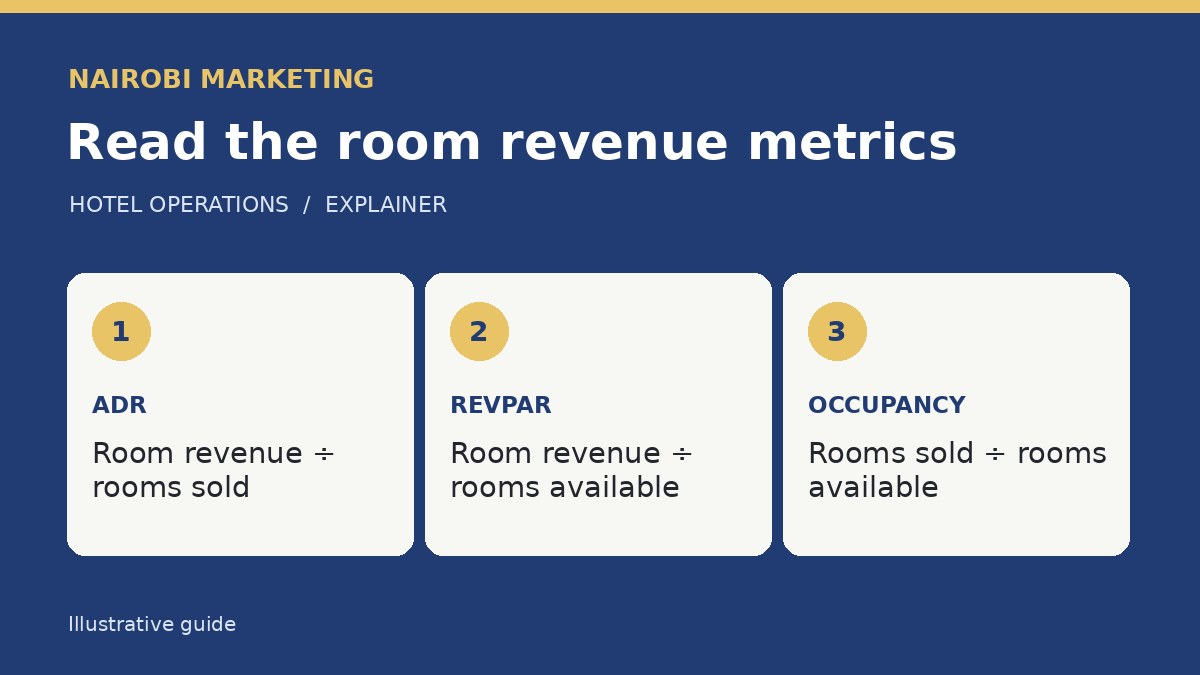
Illustrated definitions of average daily rate, revenue per available room and occupancy

Read these measures together. A higher room rate can coincide with lower occupancy; RevPAR gives you a way to compare the effect on available rooms.

ADR, or average daily rate

Room revenue divided by rooms sold.

RevPAR

Room revenue divided by rooms available.

Occupancy

The percentage of available rooms sold.

Booking window and lead time

How far in advance a booking is made.

Pickup and pace

What has been added since a prior check, and how bookings are building against a comparable period.

Length of stay

The number of nights in a booking, tracked by segment where useful.

TRevPAR

Total operating revenue per available room.

GOPPAR

Gross operating profit per available room.
Demand, seasons and forecasting

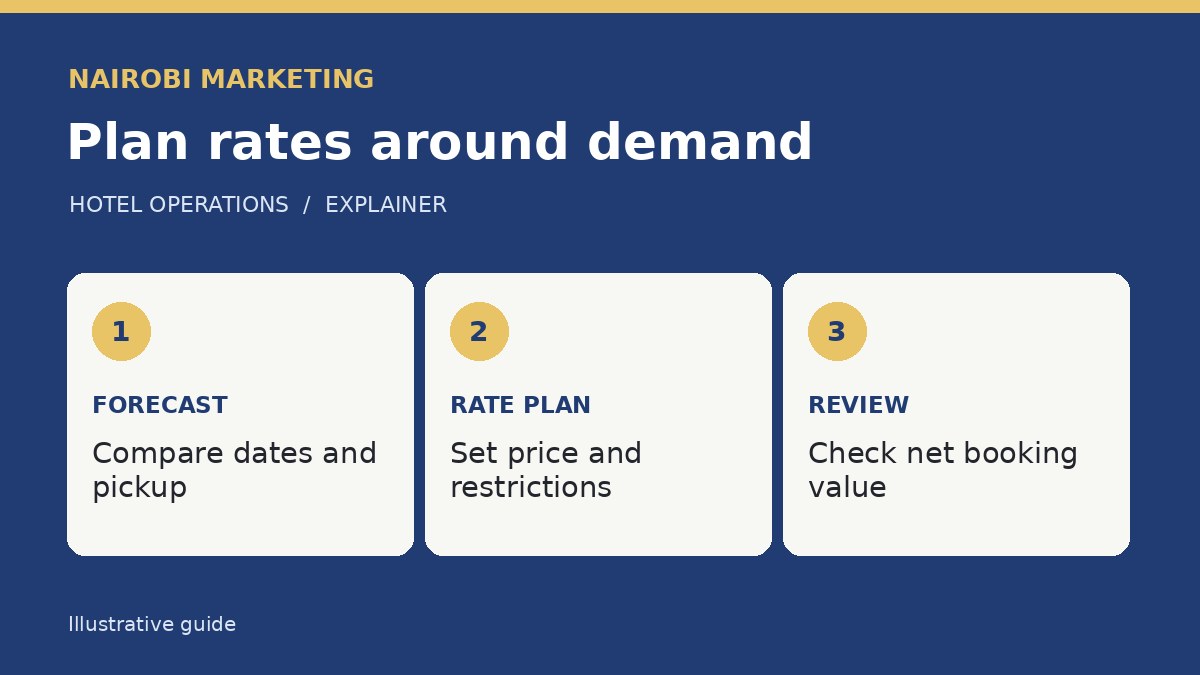
Hotel pricing workflow: forecast demand, set rates and restrictions, then review net value

A hotel revenue management strategy joins supply and demand data with market segmentation. Compare weekday business against weekend leisure and watch changes in pickup after an event announcement. Review high and low season forecasts using your own availability and booking history. For reporting beyond rooms, confirm that point-of-sale and bookings data measure the same period. Coordinate promotions with your hotel marketing plan.

Before raising rates for a peak weekend or high season, look at the booking pace for the same room type and the cost of the package. Compare that with low season demand before changing your minimum stay or cancellation rules.
Benchmarking against your competitive set

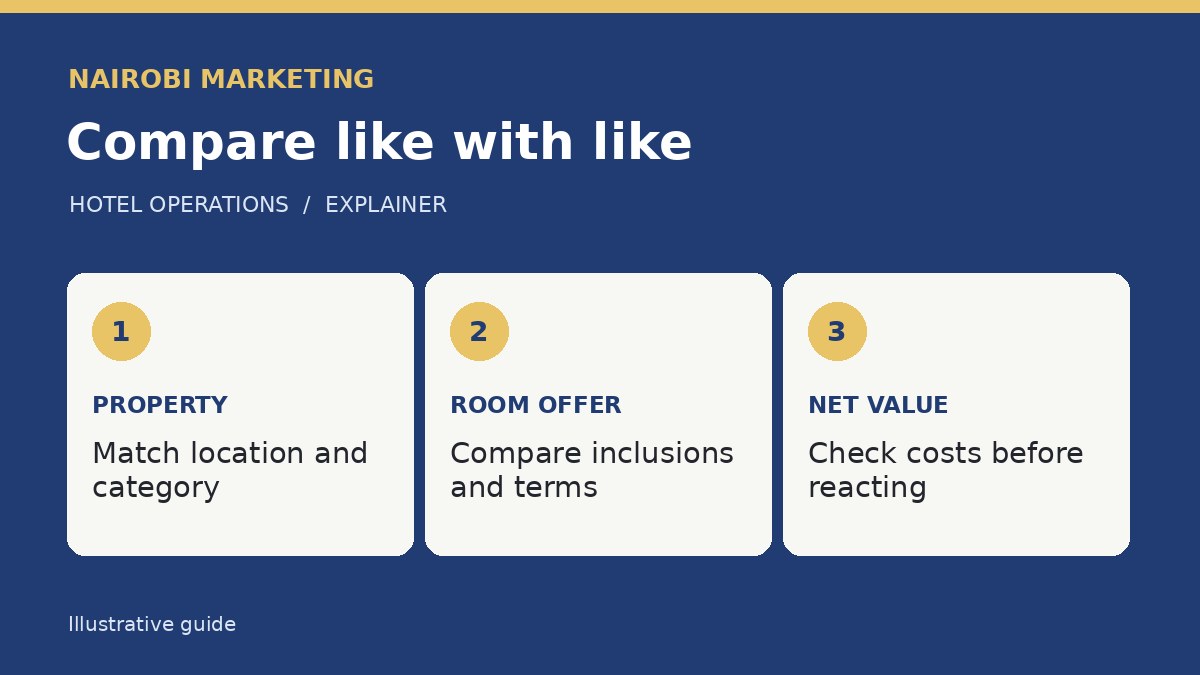
Three checks for hotel rate benchmarking: comparable property, room offer and net value

Pick a competitive set with comparable room type, location, meal plan and flexibility. Rate shopping gives a view of public offers; it does not show a competitor’s occupancy, profit or market share. Record what is actually comparable before changing your own rate.

Pricing mistakes that cost revenue

Discounting by default can make a hotel busier without improving net revenue. Opening every channel with the same rules can sell an offer on terms it cannot support. Compare room restrictions, package costs and the relevant bookings before reacting to a competitor’s headline rate.

Systems we work with

A revenue management system (RMS) can support pricing decisions, a PMS holds property data, a channel manager distributes availability and rates, and the booking engine takes direct reservations. Tools to assess include IDeaS, Duetto and Lighthouse for revenue work; Oracle OPERA, Hotelogix, eZee Absolute, ResRequest and NightsBridge for property operations; and SiteMinder, STAAH and RateGain for distribution. We scope access and working arrangements with the property before committing to any specific connection.

Hotel revenue management consultant or in-house revenue manager?

A hotel revenue management consultant can help diagnose reporting gaps, review a pricing decision and give the property a process to maintain. An in-house manager can own day-to-day controls and exceptions. Define who makes the final rate decision and when rules need approval before choosing the arrangement.

The service, explained

Rate management starts with what the room offer means.

A price is difficult to compare when the room type, occupancy, meal plan or cancellation conditions differ. We establish those details before discussing how rates should be organised across the website, booking engine and selected channels.

Room and inclusion structure

Review room categories, occupancy limits, meal plans and included experiences so each rate represents a defined offer.

Seasons and booking conditions

Organise approved dates, market segments, minimum stays and other conditions. Different rules should be understandable to the reservations team and the guest.

Available performance information

Occupancy, average daily rate (ADR), revenue per available room (RevPAR), booking pace and channel mix can inform the discussion when reliable data is available. We identify gaps rather than treating incomplete reports as certainty.

Approval rules and boundaries

The property identifies who can approve changes, any rate floors, contractual restrictions and which decisions remain with its management team.

Channel and system coordination

We confirm which information is maintained in the website, booking engine, channel manager or OTA. Access and supported workflows determine which updates can be included.

Recorded decisions and review

Document the reason for an approved change and review the available booking information afterwards. A rate change alone does not explain every movement in revenue.

A lodge near Aberdare can track guided-stay packages separately from rooms.

From brief to delivery

A rate-review process the property can follow.

01

Confirm the starting structure

Your team supplies the room offer, rate sheets, relevant contracts, booking conditions and system responsibilities. We agree which questions the review should answer.

02

Review the available evidence

We examine the reliable booking and performance data provided, identify inconsistent rules or missing information and discuss practical options.

03

Approve and coordinate

The nominated property decision-maker approves the proposal. Implementation responsibilities and permitted system changes are recorded before action.

04

Revisit the decisions

We review the agreed measures and operational feedback at the specified interval. Changes in demand, availability and booking mix remain part of the discussion.

A property near Tsavo West should compare meal inclusions and park access before treating another lodge as a benchmark.

Scope & pricing

Quote a defined review or continuing rate-management scope.

The fee depends on property and room complexity, data quality, the systems involved and whether you need a one-time structure review or continuing support. Your proposal confirms the deliverables, review frequency, approval authority and billing arrangements.

Send the room categories, current rate sheets, booking channels and the pricing questions you want to resolve. Tell us which reports are available and who maintains the rates in each system.

For approved channel-listing work, see OTA management. For attracting the intended guests through search, advertising and content, see hotel marketing. These related services have separate responsibilities and are coordinated only where agreed.

Discuss the rate review your team needs

Where we work with hotels in Kenya

A Nairobi property in Upper Hill can compare negotiated corporate rates with transient demand. A Westlands hotel may track event pickup, a Kilimani serviced apartment can compare short and long stays, and a Karen property can test when private functions change its usual room mix.

For Mombasa hotels, separate room-only business from packages that depend on local events. In Diani, a transfer from Ukunda may belong in one package but not in the base rate. In Kilifi, compare a Kilifi Creek view premium with actual demand instead of assuming all rooms book alike. A stay paired with Mnarani can be priced separately if there is a paid experience. Malindi resorts can review the cost of meal plans before discounting.

Kisumu hotels can compare weekday trade with Lake Victoria leisure demand. In Nakuru and Naivasha, track sales tied to Lake Nakuru and Lake Naivasha separately. A Nanyuki lodge can compare Mount Kenya and Laikipia demand by trip type, while a Meru property can adjust restrictions based on its own bookings.

Questions from property teams

Agree the decision boundaries before the work starts.

How does hotel revenue management differ from hotel rate management?

Rate management focuses on price decisions. Revenue management also considers inventory, channels, demand and net value. A Watamu resort can test length-of-stay offers against net revenue, not just room nights. Compare packages for Diani Beach and Mombasa stays near Moi International Airport on net value only when length of stay and transfers are comparable.

Can you review our existing pricing calendar?

Yes. Bring the current calendar, booking history and key costs so we can identify what to check first.

Do we need an RMS?

Not necessarily. Decide whether your current PMS and reporting support the decisions you need to make before adding software.

Is RevPAR enough to judge performance?

No. Consider net room revenue, distribution costs, occupancy and, where reliable, profitability measures.

Can an independent lodge use the same method?

Yes. Use comparable stays, realistic booking windows and accurate package costs.

How is the engagement priced?

Scope and price need confirmation after reviewing the property’s data, tools and required oversight.

Related services and useful answers

Explore hotel rate management by service and location.

Tell us what matters

Ready to review the rules behind your rates?

Share your room categories, rate sheets, booking channels and the pricing questions you want to resolve. Tell us who approves changes and what performance data is available.

* Required fields

Your details are used to respond to your enquiry. Privacy policy